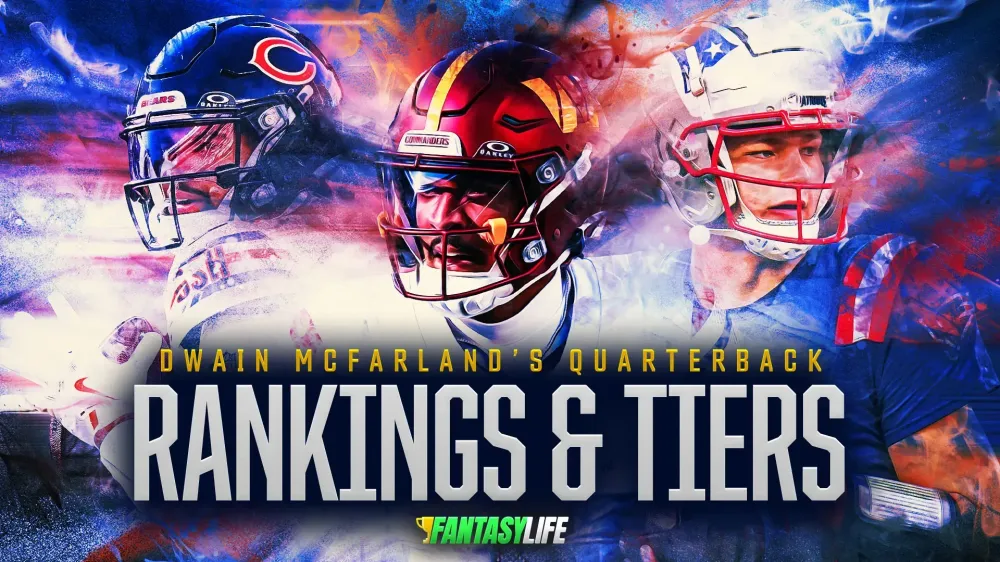
2025 Quarterback Rankings And Tiers For Fantasy Football: Where Does Jayden Daniels Land In Year 2?
Dwain McFarland reveals his quarterback rankings and tiers for the 2025 fantasy football season.
When I used to lead product and analytics teams, I would ask a team member pitching a new product feature or data idea, "So what, who cares?" The newbies would look at me with a puzzled look on their face (some of you might be thinking I am a real jerk right about now).
For the record, I was always nice when asking this question, but my point was a simple one. I wanted them to consider why people should care about the data or feature they wanted to add to the product roadmap. Was it rooted in good analysis, and would it help a user accomplish their goals?
If so, great, let's do it! If not, it went onto the "interesting, but irrelevant" scrap heap. That last part might sound harsh, but the reality is that many ideas and data points are interesting but don't help us achieve our goals. That doesn't mean we can't discuss them, but they shouldn't be at the heart of our decision-making process.
In fantasy football, our goal is to win. To achieve this, we need to target the right players. To put it even more clearly, we need to target the right *types of players*. I have dedicated thousands of hours researching which data points matter for future fantasy performance.
That doesn't mean I will get everything right. There will be misses. Football is a cruel game played with an elongated sphere that can bounce in the most unpredictable ways. The critical thing to remember is that we are playing a game of probabilities.
If we can get more things right than wrong, we have a great chance of beating our opponents. The best way for me to do that is by following the data.
One final thought before we move forward: It is a great time to be a consumer of content in the fantasy football space. We have some of the brightest minds in the industry's history using a data-driven methodology to deliver league-winning insights. It's a really cool thing.
Speaking of methodology ...
Quarterback Rankings and Tiers Methodology
This article will group players into tiers based on the following data criteria.
- Fantasy points per game (PPG)
- Historical production passing and rushing
- Age: Rounded up based on Week 1
- Offensive quality: Supporting cast and scheme
- Player average draft position (ADP): Consensus
Fantasy points per game and historical production
Like other positions, fantasy points per game in the season before remain the best predictor of future fantasy success. However, the correlation is weaker than for any other position—it turns out that playing QB is REALLY difficult.

Most of the top fantasy points-per-game performers offer a unique blend of rushing and passing upside.
Since 2019, 67% (10 of 15) of the top-three finishers at the position have rushed for 500-plus yards, averaging a sizzling 24.8 points per game.
Not exactly rocket science, huh?
Age Impact on QBs
No other position enjoys a longer career span than QBs. When comparing a signal caller's best three seasons to different career time frames, we find that prime years span a decade, and many retain pre-prime production into their late thirties.

It is essential to note that these averages are not representative of all quarterbacks, as not all quarterbacks age at the same rate. For example, there is a reason for the step down from ages 33 to 38.
- Andy Dalton fell to 70% during his age 33 to 35 seasons.
- Jay Cutler fell to 72% at age 34 and was out of the league.
- Matt Ryan hit a cliff at age 36, dipping to 70% and 74% in his final two years.
- Ryan Tannehill fell to 71% and then 48% in his age 34 and 35 campaigns.
Of course, figuring out how well dual-threat quarterbacks age is currently being studied in the lab, as Josh Allen and Lamar Jackson approach 30. That is something we will need to monitor in the coming seasons closely.
Supporting cast and scheme
While QB talent is a primary performance driver, the right supporting cast and scheme can transform mediocre talent into a viable fantasy option, and a bad cast and scheme can limit the upside of good QBs. In just the last few seasons, we have some excellent examples:
- Sam Darnold's best season before 2024 was 15.6 points per game, but he improved to 19.3 points with Kevin O'Connell and a supporting cast that included Justin Jefferson, Jordan Addison, and T.J. Hockenson.
- Tua Tagovailoa jumped from 14.7 PPG to 18.5 after the additions of Tyreek Hill and Mike McDaniel.
- Jared Goff fell from 17.3 PPG with the Rams to 14.8 in his first season with the Lions. Then the team added Amon-Ra St. Brown, Sam LaPorta, and Jameson Williams, charging Goff back up to 17.3, 17.9, and 19.2 campaigns.
We prefer the offenses with at least a mid-level signal caller and a good-to-great surrounding cast. The mid-level part of that sentence is important. There is a level of QB incompetence that can't be overcome.
Of course, the scheme also matters, and some coaches just know how to dial up the cheat codes, which leads to more fantasy points.

It's worth noting that the evolution of NFL defenses might be catching up with this sort of offensive trickery. The play-action boost decreased from 25% to 21%, and motion dropped from 13% to 11%. Of course, this could be variance in a small sample.
Player average draft position (ADP)
Never before have we had such robust market data. Thanks to the explosion of this game we love (especially best ball), thousands of real-money drafts have already taken place for the 2025 season. We must leverage consensus ADP data.
While one of the goals of the tiers is to unearth mispriced players, I want to challenge myself when takes don't align with the market (ADP). It represents something much larger and infinitely more intelligent than one person. You should be highly skeptical if you see an analyst (including me) repeatedly pounding the table for a player moving in the opposite direction of their ADP.
In "The Logic of Sports Betting," Ed Miller and Matthew Davidow had this to say:
"Market resistance is a massive red flag that you're missing something, and the best thing you can do is stop betting into the resistance and instead try to figure out what you may have gotten wrong."
Note: Consensus ADP is an average of ESPN, Sleeper, Yahoo, RTSports, and Underdog.
Enough methodology talk. Let's talk tiers.
QB Rankings and Tiers For 2025 Fantasy Football
See below for my 2025 QB rankings and tiers. Below the table, I go in-depth on each player.
| Tier | Rank | Player | Team |
|---|---|---|---|
| 1 | 1 | Josh Allen | BUF |
| 1 | 2 | Lamar Jackson | BAL |
| 1 | 3 | Jayden Daniels | WAS |
| 1 | 4 | Jalen Hurts | PHI |
| 2 | 5 | Joe Burrow | CIN |
| 3 | 6 | Patrick Mahomes | KC |
| 3 | 7 | Bo Nix | DEN |
| 3 | 8 | Baker Mayfield | TB |
| 4 | 9 | Caleb Williams | CHI |
| 4 | 10 | Kyler Murray | ARI |
| 4 | 11 | Justin Fields | NYJ |
| 4 | 12 | Drake Maye | NE |
| 5 | 13 | Brock Purdy | SF |
| 5 | 14 | Dak Prescott | DAL |
| 5 | 15 | Trevor Lawrence | JAC |
| 5 | 16 | Jared Goff | DET |
| 5 | 17 | Justin Herbert | LAC |
| 6 | 18 | Jordan Love | GB |
| 6 | 19 | C.J. Stroud | HOU |
| 7 | 20 | J.J. McCarthy | MIN |
| 7 | 21 | Cameron Ward | TEN |
| 8 | 22 | Tua Tagovailoa | MIA |
| 8 | 23 | Matthew Stafford | LA |
| 8 | 24 | Michael Penix | ATL |
| 9 | 25 | Sam Darnold | SEA |
| 9 | 26 | Geno Smith | LV |
| 9 | 27 | Bryce Young | CAR |
| 9 | 28 | Aaron Rodgers | PIT |
| 9 | 29 | Tyler Shough | NO |
| 10 | 30 | Anthony Richardson | IND |
| 10 | 31 | Daniel Jones | IND |
| 10 | 32 | Jaxson Dart | NYG |
Tier 1: Elite Dual Threats
The emergence of multiple high-end dual-threat QBs over the last five years has changed the fantasy quarterback landscape. Before this revolution, we saw significantly more turnover among the top signal callers each year, as most of them were heavily dependent on passing touchdown variance. That made taking a QB early in drafts less attractive, but those days are gone. With outs in the pass and run game, these aliens are much less prone to dips in production, and they offer nuclear upside.
I already said this in the intro, but it is worth saying again: Since 2019, 67% (10 of 15) of the top-three finishers at the position have rushed for 500-plus yards, averaging a sizzling 24.8 points per game.
Coming away with one of these four players in Rounds 3 and 4 is a priority in 2025 drafts. Through 65 drafts, Hurts, Daniels, Allen, and Jackson are on over 50% of my teams. They will help you win your league.
Remember, these are tiers—so feel free to target the one you want most, or go after the most affordable one in drafts.
 Josh Allen | Bills
- Age: 29.3 (Prime)
- Fantasy points per game: 23.8, 24.2, 26.0 (most recent first)
- ADP: Pick 24.9 (Round 2-3 turn)
On a points-per-game basis, Allen finished as the No. 2 QB last season after reeling off four consecutive No. 1 campaigns. It just doesn't get better than that.
Under Joe Brady, the Bills have morphed from a pass-happy offense to a more balanced approach. He took over in late 2023, and the impact has been evident in Buffalo's dropback rate over expectation (DBOE):
- 2022: 5.8% (4th)
- 2023: 2.1% (11th)
- 2024: -1.8% (23rd)
Over that stretch, Allen's passing yards per game have gone down each season (268, 253, 233). Of course, the Bills let Stefon Diggs go in 2023. While they have invested at the position with Dalton Kincaid (2023 Round 1 pick), Keon Coleman (2024 Round 2 pick), and Khalil Shakir ($53M extension), the group hasn't lived up to expectations outside of Shakir.
It's essential to recognize that this is still a young receiving corps, and while their performance to date doesn't scream 'incoming breakout,' at least we have youth on our side. That, and good old variance, leaves the door open for a big passing season from Allen.
Still, the veteran QB is very active in the run game. Last year, he accounted for 15% of the designed rush attempts—the sixth-best mark for the position—and was 11th in scramble rate at 7%. Most importantly, Buffalo has taken a play out of the Eagles' playbook, feeding their big-bodied QB inside the five-yard line.
- 2022: 48% (2nd)
- 2023: 40% (2nd)
- 2024: 37% (3rd)
That role has helped fuel massive rushing-TD seasons of seven, 15, and 12. Behind PFF's third-ranked offensive line and Brandon Thorn's No. 2 unit, Allen should be well protected and continue to push scores in from the goalline. There is also some room here for Brady to dial up some of the easy buttons, like we used to see from Brian Daboll with Allen.
- Play action: 21.5% (25th)
- Motion: 57.1% (10th)
Floor-ceiling projection model
The ceiling-floor model uses my projection as the median and then utilizes historical variance for each component that contributes to QB fantasy points (i.e., passing yards, passing TDs, rushing yards, etc.) to create a range of outcomes. It also accounts for the caliber of player.
- Floor: 18.8 PPG
- Median: 23.0 PPG
- Ceiling: 28.9 PPG
Yeah, that ceiling might seem rich, but if Allen were to hit a spike year as a rusher and passer in the same year, that's what it would look like. He has reached 25-plus twice.
Allen is one of the safest picks on the board in Round 3. He offers the floor-ceiling combination that makes him a priority target in drafts—especially considering our lack of a Jayden Daniels-type prospect available in the later rounds in 2025.
 Lamar Jackson | Ravens
- Age: 28.7 (Prime)
- Fantasy points per game: 26.0, 21.8, 20.4
- ADP: Pick 26.7 (Round 3)
Jackson finished as the QB1 last year after finishing third and sixth in the two seasons before. It was his best season ever as a passer, posting career-highs in multiple categories.
- Yards per game: 245
- Yards per attempt: 8.8
- Passing TDs per game: 2.41
On the one hand, we should expect some negative regression; most players don't repeat this sort of performance. On the other hand, Jackson wasn't that far off from these numbers in 2023—the first year with Todd Monken as offensive coordinator—when he averaged 230 yards with an 8.0 YPA. Still, it was a massive spike in TDs, improving from 1.50.
Jackson doesn't get the same sort of rushing work inside the five-yard line as Allen, ranking 22nd at 4%, so most of his rushing TDs must come on long runs. The rushing TDs were one of the tie-breakers for me between Jackson and Allen.
- Jackson 2023 rushing TDs: 5 in 16 games
- Jackson 2024 rushing TDs: 4 in 17 games
Still, Jackson gets his chances, ranking fourth in designed rush rate (19%) and seventh in scramble rate (8%). No other QB is more likely to rush for 1,000 yards on the season than Jackson, who has done it twice in his career (2019 and 2020).
The Ravens present a unique puzzle for defenses to solve. In an era where defenses aim to play back to take away the pass, Baltimore is one of the few offenses that can consistently run the ball and gain enough yardage per play to stay ahead in down-and-distance situations. Even though the Ravens don't have an elite set of pass catchers, they have multiple solid options in Zay Flowers (a breakout candidate), Mark Andrews, and Isaiah Likely, which is enough given the quandary Jackson and Derrick Henry create on the ground.
The Ravens remain one of the most run-oriented teams, with a -4% DBOE (27th), but they excel in efficiency, with Monken maximizing his run game to set up the pass, utilizing a 29% play-action rate (fifth-highest). The Ravens' PFF offensive line grade is middle of the pack (17th), and Thorn rates them as a solid group at No. 11.
Floor-ceiling projection model
- Floor: 18.3 PPG
- Median: 22.5 PPG
- Ceiling: 28.5 PPG
Jackson is a solid target in Round 3 of drafts, where the RBs and WRs hit a tier break. If you don't want to worry about the unknowns of some of the names in that range, just take a dual-threat stud.
 Jayden Daniels | Commanders
- Age: 24.7 (Prime)
- Fantasy points per game: 21.1
- ADP: Pick 32.6 (Round 3)
Since 2011, here are the QBs to average 20+ points per game in their first year as the full-time starter in Year 1 or Year 2:
- Cam Newton: 23.9
- Robert Griffin III: 21.1
- Patrick Mahomes: 26.9
- Lamar Jackson: 28.4
- Jalen Hurts: 21.3
- Justin Herbert: 22.7
Now that is a fantastic list, and you probably notice a trend. They were all high-end dual-threats outside of Mahomes and Herbert. Newton secured QB5, QB5, QB7, and QB1 finishes over his next four years. Griffin suffered an injury in Year 2. Lamar is Lamar. Hurts posted QB2, QB2, and QB5 campaigns.
Daniels ranked No. 1 in scramble rate (12%) and fifth in designed rush rate (18%) in his rookie season—a combination that should keep his rushing attempts sky-high for the foreseeable future.
Additionally, we haven't seen the ceiling of Daniels as a passer. Excluding the two games he played 16% and 45% of the snaps, he averaged 241 passing yards and 52.7 on the ground (including the playoffs). The man averaged 274 passing yards with 23.8 fantasy points in three playoff games, y'all!!!
The supporting cast isn't elite, but Terry McLaurin (who wants a new contract) can attack the vertical and intermediate ranges of the field, and the hope is that Deebo Samuel is a perfect fit with Kliff Kingsbury's scheme.
Floor-ceiling projection mode
- Floor: 18.2 PPG
- Median: 22.0 PPG
- Ceiling: 27.7 PPG
Daniels could take over the mantle as the QB1 this season. He and Jackson are the best two bets to rush for 800+ yards and throw for over 4,000. He goes in the middle of Round 3 and comes with much less uncertainty. Don't be afraid to smash that draft button.
 Jalen Hurts | Eagles
- Age: 27.1 (Prime)
- Fantasy points per game: 22.0, 22.4, 25.6
- ADP: Pick 40.1 (Round 4)
With the arrival of Saquon Barkley and a bevy of leading game scripts, Philadelphia leaned HARD into their ground game last year. No team led by four-plus points on a higher percentage of plays than the Eagles (47%), so they let that amazing offensive line go to work. The Eagles posted a league-low DBOE (-6.5%), only dropping back to pass on 48% of plays.
There are two vital points to make about how the Eagles' season played out in 2024:
- Jalen Hurts still scored 22 points per game despite a career-low 194 passing yards per game. This is why we LOVE dual-threat QBs. Even in a bad passing year, Hurts was a valuable fantasy asset.
- It is highly unlikely they drop back to pass only 48% of the time again. While they have the key ingredient to that sort of season (an elite running QB), it also requires so many other things to align. Over the last 10 years, only one team has posted back-to-back sub-50% dropback rates (the 2019 and 2020 Ravens).
So what does that mean for 2025? The Eagles will still be a run-oriented team, but we should see more passing from Hurts, who has better weapons than any other dual-threat on this list. Playing behind Brandon Thorn and PFF's No. 1-ranked offensive line, Hurts is in an amazing situation.
Eagles' dropback rates over the last three seasons:
- 2022: 55%
- 2023: 59%
- 2024: 48%
I have Philadelphia projected for a 54% dropback rate with Hurts passing for 225 yards per game. In the two previous seasons, he averaged 227 and 247.
As a rusher, no one offers more TD upside than Hurts, who has an amazing 14, 15, and 13 scores over the last three years. No one gets more of their team's rush attempts inside the five-yard line than Hurts.

Floor-ceiling projection model
- Floor: 18.3 PPG
- Median: 22.5 PPG
- Ceiling: 28.5 PPG
Hurts offers the best value of our dual-threat tier as a consensus Round 4 pick, making him an absolute smash selection in drafts. He goes slightly earlier on ESPN and Yahoo, where he is a Round 3 selection.

Tier 2: That Man from Cincinnati
 Joe Burrow | Bengals
- Age: 28.8 (Prime)
- Fantasy points per game: 23.0, 15.5, 22.7
- ADP: Pick 45.6 (Round 4)
Other than an injury-riddled season in 2023, Burrow has performed more like an elite dual-threat QB than a pocket passer. In his last two non-injury seasons, he averaged 289 and 280 yards with 2.5 and 2.2 TDs through the air.
Burrow has one of the best WR duos in the NFL with Ja'Marr Chase and Tee Higgins, and a coach who loves to pass the ball. Oh yeah, the defense allowed the seventh-most points per game (25.5), allowing the eighth-most yards per game (348).
Bengals DBOE rates in the last two healthy Burrow seasons:
- 2022: 7.1% (3rd)
- 2024: 8.0% (1st)
One final aspect of Burrow's game is that he isn't a zero on the ground. In his last two healthy years, he averaged 11.8 and 16.1 rushing yards. While that might not sound like much, it adds up. Since 2011, passers who averaged 275 to 299 yards per game plus 10 to 19 yards per game reached 22+ PPG (the historical top-three QB average) 71% of the time. Those with 0-9 accomplished that feat only 3% of the time.
Floor-ceiling projection model
- Floor: 17.0 PPG
- Median: 20.5 PPG
- Ceiling: 25.1 PPG
Burrow is a strong bet to finish the season as a top-six fantasy option, and is someone I don't mind drafting in home leagues if you want a proven option in Round 4. However, there are upside bets we can make later in the draft that have a chance to yield a similar season to Burrow's. Those players won't carry the same probability of success, but the opportunity costs are lower—you will have to pass some WRs, RBs, and TEs you like in Round 4 to select the Who Dey signal caller.

Tier 3: The Comfort Zone
While I don't love every quarterback in this tier at their current price due to opportunity costs, the signal-callers in this group are all good bets to perform well in 2025. Each checks one or multiple boxes across critical categories:
- Proven production
- Add value with their legs
- Play in a high-end offense
Ultimately, drafters are comfortable selecting these guys because they have either been great in the past or were good last year.
 Patrick Mahomes | Chiefs
- Age: 30 (Prime)
- Fantasy points per game: 18.3, 18.8, 24.8
- ADP: Pick 65.2 (Round 6)
Sometimes I wake up in a cold sweat in the middle of the night. It is Week 6 of the season, and we are all wondering how in the hell we did not just take one of the best quarterbacks ever at his lowest ADP since his rookie season?
Yes, the last two years haven't been ideal, with the Chiefs' weapons suffering massive injuries and Travis Kelce's decline. However, in each of the previous two seasons, we have seen a young Kansas City pass catcher erupt (once given a full-time role) from Week 14 through the playoffs.
In 2023, it was Rashee Rice with 16.4 points per game.

In 2024, Xavier Worthy did the same thing with 16.6 PPG.

If you exclude Week 18, when the Chiefs rested Worthy (3% snaps) with playoff seeds locked in, he averaged 19 points. Some are skeptical about Worthy, attributing his blowup entirely to the big Super Bowl performance (35.7), where the Eagles were well ahead. However, even when excluding that game, Worthy averaged 16.2, which is a WR1.
While Rice will likely miss time due to a suspension, at some point, both of these players will be on the field together. That could open the door for a return to fantasy prominence for Mahomes in the passing game.
The Chiefs have a credible offensive line in Thorn's "Solid Offensive Lines" tier, a mastermind playcaller in Andy Reid, and Mahomes adds value with his legs, averaging 19.2, 24, and 21.1 yards over the last three campaigns. Check. Check. Check.
Floor-ceiling projection model
- Floor: 15.6 PPG
- Median: 18.9 PPG
- Ceiling: 23.5 PPG
Mahomes still offers the ceiling we are looking for in this range of the draft. Admittedly, I haven't clicked his name often, thinking I can find something similar later, but that could look VERY DUMB. He is a mid-range QB1 with high-end QB1 upside.
 Bo Nix | Broncos
- Age: 25.6 (Prime)
- Fantasy points per game: 18.9
- ADP: Pick 86.4 (Round 8)
Many considered Nix to be a reach in Round 1 of the 2024 NFL Draft, but he meshed well with Sean Payton's scheme, finishing as the QB8 in fantasy.
The Broncos kept Nix in training-wheels mode early in the year with a 1.5% DBOE over the first five games, but opened things up to 2.5% for the rest of the year. Over that span, Nix improved his passing yards per game from 173 to 235.
Like in college, Nix was a considerable value add on the ground. He handled 10% of designed rushing attempts (8th) with an 8% scramble rate (8th). He averaged 25.3 yards on the ground.
Typically, we wouldn't discuss running backs in the context of upgrades to the passing game, but Payton has historically schemed looks to the backfield at a high rate, with nine targets per game. The Broncos selected RJ Harvey in Round 2.
Harvey offers electric playmaking ability, and J.K. Dobbins is an upgrade over Audric Estime as an early-down option. The team also added Evan Engram to patrol underneath zone coverages while Courtland Sutton attacks the intermediate and deeper areas of the field.
These aren't massive passing-game upgrades, but in a Payton-led attack, they are the types of players that can help make a difference. Pat Bryant, the team's Round 3 pick, is also a sleeper who could emerge opposite of Sutton.
The Broncos boast PFF's No. 2 o-line grade, and Thorn slotted them inside his first tier. Nix has several things working in his favor.
Floor-ceiling projection model
- Floor: 15.2 PPG
- Median: 18.5 PPG
- Ceiling: 23.8 PPG
Nix offers considerable upside because he could spike in rushing and passing categories. He is a mid-range QB1 with a chance to sneak into the top four if he runs pure.
 Baker Mayfield | Buccaneers
- Age: 30.4 (Prime)
- Fantasy points per game: 22.6, 16.8, 11.1
- ADP: Pick 75.8 (Round 7)
Mayfield was a fantasy revelation in 2024, notching the best performance of his career. He hit career highs across multiple categories:
- Touchdowns per pass attempt: 7.2% (5% career average)
- Passing yards per attempt: 7.9 (7.3 career average)
- Rushing yards per game: 22.2 (11.9 career average)
While I love the Bucs' weapons, we do have some concerns. Mike Evans is 32. Chris Godwin (who has a dislocated ankle) isn't practicing yet. Starting left tackle Tristan Wirfs is on the PUP. While the coaching staff remains optimistic about Wirfs, Todd Bowles told us last year that Godwin might return for the playoffs—he still isn't practicing.
On the bright side, Tampa added a good first-round WR prospect to the mix in Emeka Egbuka, who I can't stop drafting.
Here's the thing. Even if all three of those weapons stay healthy, Mayfield isn't likely to repeat his 2024 performance. It's hard to repeat career-high numbers back-to-back. Even elite players in their prime, like Mahomes, Peyton Manning, and Aaron Rodgers, fell victim to regression compared to their career-high seasons.
I am not saying Mayfield is a bad pick. He has weapons and a good offensive line. However, we thought many of the same things about the Texans heading into last year, and we overdrafted C.J. Stroud. It's just something to keep in mind.
Floor-ceiling projection model
- Floor: 15.1 PPG
- Median: 18.2 PPG
- Ceiling: 22.6 PPG
While Mayfield deserves to rank among the top 12, he grades similarly to other players in this tier who are selected later. Glass half full view: He could perform similarly to Burrow at a three-round discount. Glass half empty view: He could be 2024 C.J. Stroud.
Tier 4: The Raw Ingredients
This tier is all about the traits that can unlock fantasy greatness. Many of these players won't be comfortable clicks, but the upside is substantial, and the prices are affordable. If you miss out on an elite dual-threat option, this is a great window to target.
It is okay to get these guys wrong. We want to take swings at players that can offset the elites, and that means striking out is a potential result. We can recover because the prices aren't too high, and if you are concerned, you can pair them with another QB later.
 Caleb Williams | Bears
- Age: 22.8 (Prime)
- Fantasy points per game: 15.6
- ADP: Pick 114.4 (Round 10)
Yes, Caleb Williams was bad as a rookie. It happens! That doesn't diminish the traits he brings to the game. Williams is one of a handful of QBs who can extend plays and similarly hit home runs to the elite options. Does he need to take more singles and doubles? That will be the focus of Ben Johnson. And it has a good chance of working because Johnson's scheme is designed to force those layups.
In the history of covering fantasy football, I can't remember an offensive line receiving such a massive upgrade. I reached out to Brandon Thorn—the leading offensive line expert in our industry—to see if he recalled such a climb, and he couldn't think of one either.
- New left guard: Joe Thuney
- New center: Drew Dalman
- New right guard: Jonah Jackson
- Drafted right tackle: Ozzy Trapilo to push Braxton Jones
The Bears unit now ranks in Thorn's top ten and is the No. 4 graded squad by PFF.
Chicago also added Colston Loveland—the fifth-best TE prospect in the history of the Rookie Super Model—in Round 1 of the NFL Draft.

They didn't stop there. In Round 2, they snatched WR Luther Burden III, who joins forces with DJ Moore.
Let's recap:
- Coaching: Improved
- Offensive line: Improved
- Weapons: Improved
But we can't stop there. Williams rushed for 489 yards (28.8 per game) on 81 attempts last year. Oh yeah, he didn't score a rushing touchdown. Since 2011, QBs with 70 to 90 rushing attempts averaged 3.6 TDs.
Floor-ceiling projection model
- Floor: 14.9 PPG
- Median: 18.2 PPG
- Ceiling: 23.4 PPG
I have Williams as my No. 9 quarterback in the Fantasy Life rankings—the highest on the team. Williams is one of the few quarterbacks in the NFL who could pass for 4,500 yards and rush for 500. That gives him HIGH-END QB1 UPSIDE. He might be a complete bust, but with a Round 10 price tag, I am willing to gamble.
 Kyler Murray | Cardinals
- Age: 28.1 (Prime)
- Fantasy points per game: 18.5, 18.7, 18.4
- ADP: Pick 99 (Round 9)
Murray has fallen to low-end QB1 territory over the last three years, finishing 11th, 10th, and 11th, averaging 18.5 points per game.
It is fair to doubt Murray as a passer at this point in his career. His 271 yards per game in 2021 look like an outlier after averaging 222 the last three years. Still, he has eclipsed 30 yards rushing per game every season of his career. He has notched at least four rushing touchdowns in every healthy season, with a spike campaign of 11 back in 2020.
Since 2011, comparable quarterbacks based on their last three seasons have demonstrated an ability to score 22+ points per game 86% of the time. Of course, Murray is on the list of guys who haven't accomplished that in the cohort. Still, it is on the table because variance is going to variance, y'all.
The Cardinals need Marvin Harrison Jr. to step up in a big way—which is a possibility—and would give Murray another quality weapon to pair with Trey McBride. From 2019 to 2021, Murray averaged a TD pass on 5% of his passes, which has fallen to 3.7%. The league average is 4.6% for a starter. We have some room for positive regression here if Maserati Marv can get it in gear.
There are some concerns surrounding his offensive line, which ranks at the bottom for Thorn and lands in the middle at No. 16 for PFF.
Floor-ceiling projection model
- Floor: 15.3 PPG
- Median: 18.6 PPG
- Ceiling: 24.1 PPG
Ultimately, Murray projects as an average to below-average passer, but he offers spike potential in two categories, which gives him the sixth-highest ceiling in the model. Murray is a low-end QB1, but offers high-end QB1 in pure runout.
 Justin Fields | Jets
- Age: 26.5 (Prime)
- Fantasy points per game: 17.4, 19, 20.6
- ADP: Pick 116.7 (Round 10)
Fields signed a two-year, $40 million contract with $30 million guaranteed. While I can't vouch for the former Round 1 NFL Draft pick as the answer for an NFL team, his potential value in fantasy football is undeniable thanks to his rushing prowess. On a fantasy points per-dropback basis, Fields is borderline in two of his last three campaigns.
- 2022: 0.70
- 2023: 0.52
- 2024: 0.62
For reference, Lamar Jackson's marks were 0.65, 0.62, and 0.82. So Fields could look like Lamar in a non-blowup passing year (which Jackson did last year).
Over the last three seasons, Fields has been one of the most heavily utilized QBs in the run game.
- Designed rush attempts: 21% (4th)
- Scramble rate: 12% (1st)
Over that span, he has averaged 9.1 attempts, 55 yards, and 0.45 rushing TDs per game. In other words, Fields produces 8.2 fantasy points per conest on rushing alone. The new Jets' signal caller averaged 142 attempts in his two seasons as the Bears' starter, and we have him projected for 132 in 2025.
Unfortunately, he has been downright awful as a passer, averaging only 180 yards in contests where he has played 90% or more snaps. Despite only having Fields projected for under 3,000 yards and under 20 passing TDs, he still deserves merit as a top 12 option.
Since 2010, we have seen seven QBs throw for less than 3,300 yards with 120 to 140 attempts. They averaged 19.2 points per game with an average finish of QB12. Fields was the QB8 over the first six weeks of 2024 with 18.9 per game!
Floor-ceiling projection model
- Floor: 15.6 PPG
- Median: 19.0 PPG
- Ceiling: 23.7 PPG
Fields falls below Williams and Murray in the tier because of his long-standing woes as a passer. His upside is primarily attached to one thing: his legs. Still, he is a great low-end QB1 target who offers mid-range QB1 upside because he is REALLY good at that one thing.
NOTE: Fields was limped off the field and was carted off (in the passenger seat) on Tuesday, July 24th, at training camp with an apparent lower leg injury. Be sure to monitor the situation.
 Drake Maye | Patriots
- Age: 23 (Prime)
- Fantasy points per game: 15.0
- ADP: Pick 132 (Round 11/12)
On the surface, it was a rough year for Maye as a rookie with only 208 yards passing per game. But if we dig a little deeper, he averaged 235 in the games where he played 90% of the snaps, along with 37 rushing yards for 17.1 fantasy points per game.
That is impressive considering the lack of any explosive passing-game weapons. This offseason, they added Stefon Diggs, who appears on track for Week 1 (mid-season ACL) based on camp reports.
They also drafted an explosive playmaker out of the backfield in TreVeyon Henderson in Round 2 and added WR Kyle Williams in Round 3. While we can't label those additions as massive upgrades, they should still be an improvement over the 2024 model.
Mike Vrabel takes over as the head coach with Josh McDaniels as the play caller. Historically, Vrabel has opted for a conservative style of football, aiming to win close games. That will likely be their recipe for success in 2025: rushing to create efficiency in the passing game.
There could be a silver lining in that approach. Maye posted a 14% designed rush rate in college, but only accounted for 3% of the Patriots' workload as a rookie. That is something we could see change under new leadership. Maye already ranked second in scramble rate (11%) as a rookie.
The Patriots' offensive line ranks in the bottom five for both PFF and Thorn despite adding Will Campbell early in Round 1 of the NFL Draft.
Floor-ceiling projection model
- Floor: 15.2 PPG
- Median: 18.5 PPG
- Ceiling: 23.6 PPG
Maye is poised to make a run at a breakout campaign in 2025. He is hardly a lock, but he offers the combination of rushing and passing ceiling that makes him worth targeting ahead of ADP. He is a QB we could select in Round 5 of the fantasy drafts in 2026.
Tier 5: Proven Commodities
If you don't have the stomach for some of the uncertainty tied to the upside for the group of signal callers above, that's OK. You can target this tier instead, which has several steady names that offer top-12 upside in fantasy with less risk. Depending on your bench size and draft strategy, pairing one of these names with a name from the group above is also an option. Historically, I haven't been a big proponent of drafting two QBs, but more fantasy players are doing it now, and you know if you are in that type of league.
 Brock Purdy | 49ers
- Age: 25.7
- Fantasy points per game: 19, 19.4, 15.8
- ADP: 111 (Round 10)
Purdy has QB9 and QB6 finishes on his resume over the last two seasons, and he is one of the reasons I don't draft Baker Mayfield much. Purdy passed for 258 and 268 yards per game over the last two years. However, like Mayfield, he upped his rushing yards from nine to 22 per game.
That is a combination we can get behind, but his touchdowns per attempt fell from 1.94 to 1.33 with key 49ers options struggling. Despite that, Purdy still delivered eight fantasy performances with 20-plus points.
Deebo Samuel is gone, and Brandon Aiyuk (ACL) could miss a significant portion of the season. While that is concerning, Jauan Jennings played well last year, and George Kittle remains one of the top-three tight ends in the game. With Christian McCaffrey returning to the lineup and Ricky Pearsall hoping to build off a strong finish to 2024, there are enough weapons for Kyle Shanahan to work his magic.
Shanahan ranks second in motion rate at the snap over the last three seasons (64%), and keeps defenses on their toes with a strong run game. Thorn has the offensive line ranked as below-average, while PFF ranks them No. 12, thanks to the return of Trent Williams and the emergence of Dominick Puni.
Floor-ceiling projection model
- Floor: 14.6 PPG
- Median: 17.7 PPG
- Ceiling: 22.7 PPG
I nearly placed Purdy in Tier 3 right next to Mayfield. He has two top-10 finishes on his resume and could continue to thrive as a runner. There were just enough questions about the age and health of his weapons to push him to Tier 5, but he is still a fine low-end QB1 with mid-range QB1 upside.
 Dak Prescott | Cowboys
- Age: 32.1 (Prime)
- Fantasy points per game: 15.8, 20.7, 18.0
- ADP: 121 (Round 10/11)
After finishing second in the MVP voting in 2023, 2024 was a forgettable one for Prescott. He only played eight full games before a hamstring injury ended his campaign.
If we zoom out a little, a different picture emerges. In Prescott's last two healthy seasons (2021 and 2023), he averaged 21 and 20.7 points with 278 and 266 yards per game. He isn't the runner he once was, but he can get you over 10 yards per game and punch in a couple of scores.
Mike McCarthy is gone, with Brian Schottenheimer taking over an offense without a running back to hang their hat on. With the addition of George Pickens, we could see one of the more pass-happy offenses in the league.
Dallas has invested heavily in their offensive line, using Round 1 picks in three of the last four seasons. They rank toward the middle of the pack in Thorn's rankings and are No. 23, per PFF.
Floor-ceiling projection model
- Floor: 15.3 PPG
- Median: 18.4 PPG
- Ceiling: 22.4 PPG
If George Pickens plays up to his potential, he and CeeDee Lamb will form the best WR duo of Prescott's career. In a pass-first attack, expect a bounce-back campaign, making Prescott a high-end QB2 with QB1 upside.
 Trevor Lawrence | Jaguars
- Age: 25.9 (Prime)
- Fantasy points per game: 14.9, 18.0, 18.6
- ADP: 146 (Round 13)
I have been one of Lawrence's more vocal critics over the years, but the Jaguars have made significant changes this offseason. Last year was his worst season, but Lawrence notched QB12 and QB8 finishes in the two years before.
His passing and rushing numbers were solid in those seasons, making him an intriguing option that could spike in both categories.
- 2022: 242 passing, 17.1 rushing
- 2023: 251 passing, 21 rushing
The Jaguars added Travis Hunter with the third pick in the NFL Draft to partner with rookie sensation Brian Thomas Jr. We don't know how much Hunter will get to play on offense yet. However, he will get his opportunities when on the field under new head coach Liam Coen, who helped ignite the Buccaneers' offense last season.
One of the biggest concerns for Lawrence is the offensive line, which grades at the bottom of the pack for both Thorn and PFF.
Floor-ceiling projection model
- Floor: 14.5 PPG
- Median: 17.6 PPG
- Ceiling: 22.9 PPG
Lawrence's sneaky upside as a passer and a rusher keeps the light on for a strong QB1 spike season if everything comes together under Coen. I am ahead of consensus on Lawrence as a high-end QB2 with QB1 upside.
 Jared Goff | Lions
- Age: 30.9 (Prime)
- Fantasy points per game: 19.2, 17.9, 17.3
- ADP 115 (Round 10)
Goff posted his first top-12 fantasy season since 2018 last year, thanks to career highs in multiple categories.
- Touchdowns per attempt: 6.9% (4.6% career average)
- Yards per attempt: 8.6 (7.4 career average)
- Completion rate: 76% (69% career average)
Over the last two seasons, he posted 269 and 272 passing yards per game with one and three rushing yards per contest. Since 2011, quarterbacks who averaged 275 to 299 passing yards per game but less than 10 yards rushing struggled to hit big ceilings. Out of 33 comparisons, only one (3%) notched a top-three finish.
Don't get me wrong, y'all. Goff is a solid passer playing in an offense loaded with playmakers and a strong offensive line. The problem is he hit his ceiling last year, and it was QB8. Now he is likely due for regression, which will likely place him in the high-end QB2 range. He was the QB13 and QB15 in 2023 and 2022.
Ben Johnson is gone as the playcaller. The Lions ranked No. 1 in play action (32%) and No. 9 in motion at the snap over the last two seasons. It is hard to imagine John Morton making significant changes, but whether he can design and implement a successful version of this scheme is at least a question worth considering.
Floor-ceiling projection model
- Floor: 14.6 PPG
- Median: 17.5 PPG
- Ceiling: 20.5 PPG
Goff offers a similar median and floor projection to the rest of the players in this tier, but his lack of rushing ability limits his ceiling. He is entirely reliant on a spike passing season. He is a high-end QB2. Don't reach for him on platforms like Sleeper and Yahoo, where he is the 10th QB off the board.
 Justin Herbert | Chargers
- Age: 27.5
- Fantasy points per game: 16.8, 18.4, 17.3
- ADP: 120 (Round 10)
When you watch Herbert play football, it is a sight to behold. Many film grinders consider him one of the best quarterbacks in the NFL. However, after back-to-back 22.7 PPG seasons to start his career, he has fallen off in fantasy.
Beneath the surface, last year was slightly better than it looked. Herbert battled an ankle injury early, and the Chargers relied heavily on the run with a -5.2% DBOE over the first four games. However, after the bye, they opened things up with a 2.3% DBOE.
Pre- and post-bye numbers per game:
- Pre-bye: 25 dropbacks, 145 pass yards, 1.3 pass TDs, six rush yards, 11.1 PPG
- Post-bye: 37 dropbacks, 252 pass yards, 1.4 pass TDs, 20 rush yards, 17.9 PPG
Herbert's points per dropback (0.49) were close to his first two seasons (0.52), which provides some reason for optimism. While the team will likely never be as pass-heavy as those 2020 and 2021 teams, there have been rumblings about Herbert running more. He has already eclipsed 15 rushing yards per game in four of five seasons.
The Chargers bolstered their run game, taking Omarion Hampton in Round 1 of the NFL Draft, but they also added a new weapon for Herbert in Round 2 with the selection of WR Tre Harris. Ladd McConkey was a WR1 in fantasy from Week 3 through the playoffs, but they need Harris or Quentin Johnston to step up as a quality No. 2 to open up more upside in the passing attack.
Greg Roman dialed up motion at the snap 59% (6th) and utilized play action on 32% (2nd) of pass plays in 2024. Even if Herbert doesn't get massive passing volume, he could win on efficiency in a similar way to Brock Purdy and Jared Goff.
Herbert gets the benefit of playing behind a solid offensive line that ranks inside the top 10 for PFF and Thorn.
Floor-ceiling projection model
- Floor: 14.1 PPG
- Median: 17.1 PPG
- Ceiling: 21.4 PPG
Herbert has QB1 pedigree, but he projects as a mid-range to high-end QB2 to start the season. If Tre Harris erupts or Herbert gets additional touches on the ground, it would open the door to QB1 upside.
Tier 6: They Did It Once Before
Both of these young signal callers have a QB1 finish on their resume but suffered a down year in 2024.
 Jordan Love | Packers
- Age: 26.9 (Prime)
- Fantasy points per game: 15.9, 19.6
- ADP: 137 (Round 12)
While the fantasy points went down, some of Love's underlying data points improved in his second season as the starter.
- Yards per attempt: 7.2 → 8.0
- Touchdowns per attempt: 5.5% → 5.9%
But the passing volume was down. The Packers held a blowout lead on 20% of their snaps (second-most), far ahead of the 8% league average. But it wasn't just the leads. The Packers DBOE, which accounts for leads, was the second-most run-heavy (-6.4%). If you exclude the games where Malik Willis played most of the snaps, it was -5%.
Love averaged 14.8 rushing yards per game in 2023, but that number fell to 5.5 last season. In 2024, his designed run rate fell from 7% to 3% due to injuries, but his scramble rate was the same at 3%.
Ultimately, the Packers will likely remain a balanced offense, but we should expect some positive regression in their passing game. They added WR Matthew Golden in Round 1 of the draft to pair with Jayden Reed and Tucker Kraft, who have both flashed upside in the last two seasons.
In two seasons with Love under center, Matt LaFleur has dialed up play-action on 26% of dropbacks (10th) and utilized motion at the snap on 58% (6th).
The offensive line rates near the middle of the pack in Thorn and PFF's rankings.
Floor-ceiling projection model
- Floor: 14.2 PPG
- Median: 17.2 PPG
- Ceiling: 21.4 PPG
Love is a mid-range QB2, but offers efficiency QB1 spike upside. The Packers boast a high-quality offense thanks to an excellent scheme under LaFleur, but to regain top-12 status, we need more out of Love as a runner and a step forward by the receiving corps.
 C.J. Stroud | Texans
- Age: 23.9 (Prime)
- Fantasy points per game: 14.1, 19.1
- ADP: 137 (Round 12)
After finishing as the QB7 as a rookie, fantasy managers were uber hyped to take Stroud early in 2024 drafts after the addition of Stefon Diggs. However, he finished as QB28. His passing yards fell from 274 yards per game to 219. His YPA dropped from 8.2 to 7.0.
Now fantasy players are left to wonder whether Year 1 was a random spike season or if they should buy the dip as a Round 12 selection in 2025. One major challenge is the offensive line, which ranks dead last for Thorn and PFF. However, the team did add six new bodies. That should create healthy competition and allow the team to try different combos if things aren't going well.
On a positive note, the team drafted WR Jayden Higgins in Round 2 of the NFL Draft and went back to the well in Round 3, selecting Jaylin Noel. Houston also added Christian Kirk to round out a receiving corps led by a budding star, Nico Collins.
The team also made a switch at offensive coordinator, moving on from Bobby Slowik to Nick Caley. Caley is the latest Sean McVay disciple to land a bigger role, and given how the Texans' offseason additions, we could see more 11 personnel (three-WR sets). The Rams finished first in motion at the snap and third in play action, which are additional elements Caley could try to implement, although Slowik used those elements fairly often.
Floor-ceiling projection model
- Floor: 13.6 PPG
- Median: 16.5 PPG
- Ceiling: 20.6 PPG
Stroud is a mid-range QB2, but he could surge into a low-end QB1 season if the offensive line improves and his new weapons step up.
Tier 7: Unproven Upside
- J.J. McCarthy | Vikings | 22 (Pre-Prime): McCarthy will try to be the next Kevin O'Connell quarterback to break into the top 12 at the position. Kirk Cousins (QB12, QB5) and Sam Darnold (QB7) were top-12 options. McCarthy is more athletic than either of those players, but wasn't a big part of the run game in college. If he spins it like his predecessors and adds value in the run game, it will be hard to fail with an elite supporting cast. I nearly put McCarthy in Tier 4 behind Drake Maye. He is a great sleeper pick at QB.
- Cam Ward | Titans | 23 (Pre-Prime): The No. 1 overall pick in the 2025 NFL Draft averaged 332 yards and tossed 39 TDs in his final year at Miami. He averaged 303 yards and 32 TDs for his career. The man can also move around a little, averaging 26 rushing yards at Miami. The supporting cast isn't high-end, but Ward could surprise in 2025. For now, he is a low-end QB2.
Tier 8: Pure Pocket Passers With Weapons
- Tua Tagovailoa | Dolphins | 27.5 (Prime): Tagovailoa has one top-12 finish in points per game in five seasons. He can pile up the passing yards, but is non-existent in the run game. That makes him reliant on a passing TD spike season. He has the weapons to make that happen, but even then, his ceiling isn't much higher than low-end QB1.
- Matthew Stafford | Rams | 37.7 (Post-Prime): The Rams moved on from Cooper Kupp but added Davante Adams to go along with Puka Nacua. Sean McVay's offenses rank seventh in play action (28%) and third in motion at the snap (65%) over the last three years. Stafford notched a QB11 finish in his first season with the Rams in 2021, thanks to a TD spike season at 6.8% per attempt. Since then, he's collected QB26, QB17, and QB27 PPG finishes. He has the scheme and the weapons, but is an absolute zero in the run game, making him 100% reliant on a spike passing TD season to surge into the top 12.
- Michael Penix | Falcons | 25.4 (Prime): Penix took over as the starter for the last three games of 2024 and averaged 14.9 PPG. He has a gunslinger mentality, pushing the ball downfield (10.1) aDOT, looking for chunk plays. He has three quality passing game weapons in Drake London, Darnell Mooney, and Bijan Robinson. Zac Robinson brought the motion concepts with him from the Rams, ranking fifth (63%). Yet, he forgot to pack play action in his bags (14%, last). Penix doesn't offer much as a rusher, but if one guy from this tier were to surprise us with new rushing upside in 2025, it would be Penix in Year 2.
Tier 9: Rounding Out the QB2s
- Sam Darnold | Seahawks | 28.3 (Prime): Darnold parlayed his QB7 finish with the Vikings into a big payday in Seattle. Whether he can succeed outside the nurturing Kevin O'Connell biosphere is a big question. Prior to his time with O'Connell, Darnold's best fantasy finish was QB23.
- Geno Smith | Raiders | 34.9 (Post-Prime): Smith has averaged 16.5, 15.8, and 19.0 points over the last three years. In 2022, he notched a QB7 finish with a 5.2% passing TD rate and 366 yards on the ground. Geno can spin it and has some utility on the ground, which gives him a chance for a spike year. He doesn't have any explosive downfield weapons but has a great group of intermediate and underneath targets in Brock Bowers, Jakobi Meyers, and Ashton Jeanty. He gets to play in a dome rather than the weather in Seattle, but he is in his post-prime era.
- Bryce Young | Panthers | 24.1 (Prime): Young upped his PPG from 10.9 to 14.9 in Year 2. He was benched for Andy Dalton in Week 3, but was much better upon return, averaging 19.3 points. Over that period, he upped his scramble rate to 9%. He finished the year with 249 yards and six rushing TDs. If he can take another step in the passing department (172 and 180 per game) with the arrival of Tetairoa McMillan, Young could make some noise. He is a sleeper candidate at QB in 2025.
- Aaron Rodgers | Steelers | 41.8 (Decline): Rodgers averaged 15.7 and 15 PPG in his last two full campaigns, averaging 217 and 229 passing yards. Once a 20-yard-per-game rusher, his skills have drastically diminished. He averaged 3.5 rushing yards per game in 2024. In a run-heavy scheme under Arthur Smith (-5% DBOE) with only one playmaker in DK Metcalf, it's hard to get too excited.
- Tyler Shough | Saints | 26 (Prime age, but an old rookie): Shough will battle Spencer Rattler for the starting role, but his second-round draft capital gives him a significant edge in the race. Kellen Moore is now the head coach in New Orleans, and the team boasts a solid set of weapons, including Chris Olave, Rashid Shaheed, and Alvin Kamara. Historically, we haven't seen seven-year college players like Shough succeed, but some of the film grinders are believers. On a positive note, he averaged 25 rushing yards per game with an 8% scramble rate.
Tier 10: Dual-threat Stashes
- Anthony Richardson | Colts | 23.3 (Prime): Richardson has averaged 17.4 points over his two-year career in games where he reached 90%+ snaps. He has been Justin Fields-like with 181 passing yards and 48.4 rushing yards per game. He re-injured his shoulder in minicamp, but will ramp up activity in training camp. If Richardson ever gets under center, he will offer spike potential thanks to his rushing ability, making him a stash option if you don't like the upside of your QB1.
- Daniel Jones | Colts | 28.3 (Prime): Jones has averaged 14.5, 18.5, and 15.6 in the last three seasons, where he played at least 10 games. Despite offering some upside in the rushing department with 32.5 yards per game over that span, his fantasy points per dropback rates are well below average (0.33, 0.38, 0.52) compared to other dual-threats. The Colts have a solid set of passing weapons in Josh Downs, Michael Pittman Jr., and first-round pick Tyler Warren. That would represent the best group of Jones' career. The Colts rank fourth in play action (28%) under Shane Steichen. If allowed to start the whole year, Jones could challenge his 2022 season when he finished as the QB10.
- Jaxson Dart | Giant | 22 (Pre-Prime): Dart averaged 47 rushing yards per game in college. While evaluating him as a passer isn't easy due to the gimmicky nature of the Ole Miss attack, he has the ingredients to spike in two categories if it works out. He could surprise with QB1 upside should he become the Giants' starter this year.

Join Our Newsletter
Trusted by 400,000+ fantasy football players. Get access to Fantasy Life's free award winning newsletter and tools, all in one step.
By registering or logging in, you agree to our Terms of Use and Privacy Policy.
Players Mentioned in this Article
 JoshAllenQQBBUF
- PPG
- 17.29
 LamarJacksonQBBAL
- PPG
- 13.63
 JaydenDanielsQQBWAS
- PPG
- 11.72
 JalenHurtsQBPHI
- PPG
- 11.36