Broncos Team Needs For The 2026 Offseason: Focus on Pass Catchers For Bo Nix
Ian Hartitz highlights the top three needs that the Denver Broncos should focus on in the 2026 offseason after their AFC Championship loss.
The Broncos earned the AFC's top seed on their way to winning their most regular-season games since 1998 before ultimately losing to the Patriots in the AFC Championship game. This was a great football team … although their "expected" win-loss record (based on point differential) was actually just 11-6. Denver experienced more than a few close calls along the way—their 11-2 record in one-score games reflects the reality that this wasn't exactly a complete juggernaut.
- 2025: 14-3 (+90 point differential, preseason win total: 9.5)
- Points per game: 23.6 (14th)
- EPA per pass: +0.1 (13th)
- EPA per rush: -0.07 (16th)
- Points per game against: 18.3 (third)
- EPA per pass against: -0.04 (ninth)
- EPA per rush against: -0.11 (eighth)
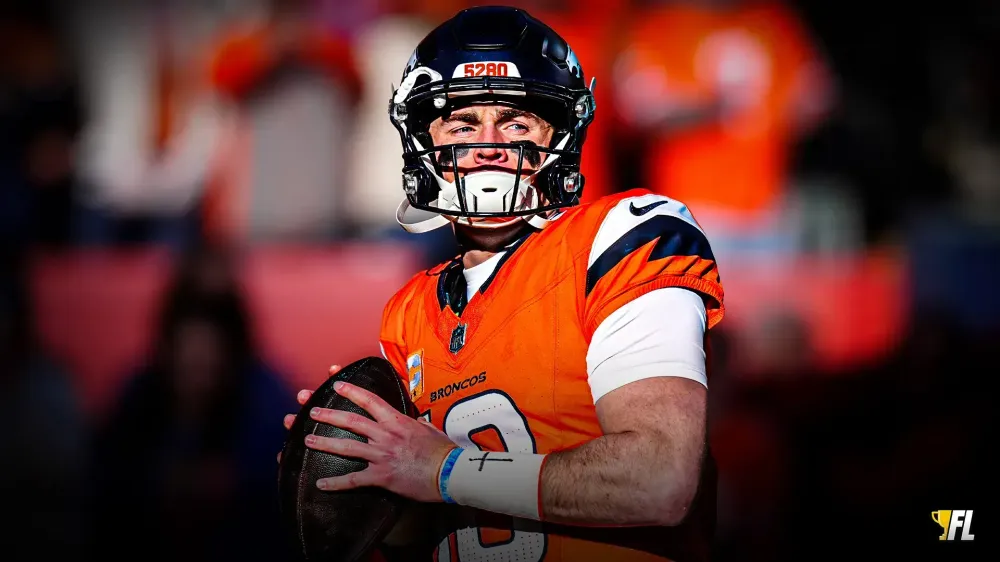
Thanks in large part to Bo Nix's affordable rookie contract, making him one of the cheapest starting QBs in the NFL, Denver has ample cap space to go along with plenty of draft capital to help improve what already looks like one of the league's more complete rosters.
What Do The Denver Broncos Need To Address For 2026?
Linebacker
Starting LB Alex Singleton and backup Justin Strnad are both free agents, leaving the defense very thin at the position outside of Dre Greenlaw, who deserves credit for overcoming recent Achilles and quad injuries and returning to a high level of play.
Additionally, nitpickers of arguably the best defense in the league could point to this position group as the relative weak spot. While it makes sense that the elite ability of Pat Surtain would persuade opposing offenses not to target their wide receivers as often, the Broncos nevertheless were one of only 10 defenses to allow over 1,000 yards to opposing tight ends last season.

Premium
Go FantasyLife+
Your league is unique. Your advice should be too. Get personalized tools, rankings, and projections tailored to your fantasy football league settings.
Pass Catcher
No. 1 WR Courtland Sutton isn't going anywhere, but none of Pat Bryant, Marvin Mims nor Troy Franklin have exactly established themselves as high-end starters during their respective short careers. Meanwhile, alleged "Joker" Evan Engram (28.8 yards per game) struggled to play a meaningful year-one role in this passing game, and tight end depth is in question with Adam Trautman and Lucas Kroll entering free agency.
Add it all together, and this is the league's 12th-cheapest group in terms of 2026 dollars devoted to the WR and TE rooms. Not a complete disaster, but Denver's 67.8 team PFF receiving grade (26th) reflects the reality that this looks a lot like a below-average group of pass catchers from top to bottom.
Running Back
Rookie RJ Harvey had a nose for the end zone and flashed some solid receiving chops on his way to gaining 896 yards and scoring 12 touchdowns, although he did post bottom-10 numbers at the position in yards per carry (3.7), yards after contact per carry (2.7) and explosive rush rate (2.7%) alike.
Maybe simply bringing back free agent J.K. Dobbins is the answer here. After all, the injury-riddled veteran has consistently worked as one of the game's better ball carriers whenever healthy enough to suit up over the years. Per Next-Gen Stats:
- 2020: +1.47 rush yards over expected per carry (RB2)
- 2021: Injured (ACL)
- 2022: +1.05 (RB4)
- 2023: Injured (Achilles)
- 2024: +0.6 (RB16)
- 2025: +1.36 (RB4)
Whether the Broncos decide to lean on Harvey as their featured back or not: This is the league's third-cheapest RB room entering 2026 due to Jaleel McLaughlin and Tyler Badie (ERFA) joining Dobbins as free agents. Depth is needed.
Honorable Mention
This offensive line has a very real case as the best in football—the *only* critique here would be the fact that Denver joins Cleveland as the only two teams to use just one top-three-round pick on their big uglies during the last five drafts.
If I Were The GM …
I'd make a real effort to get a YAC-minded playmaker in the wide receiver or tight end room. The team continued to insist on only featuring Marvin Mims in a gadget-esque manner in 2025, Troy Franklin ranks second-to-last in yards per target among 50 qualified receivers over the past two seasons and Pat Bryant (one game with more than 43 yards) didn't exactly look like the next-big-thing in year one. Free agent WR Deebo Samuel would be a great fit if Father Time hasn't completely come for him just yet, otherwise Texas A&M speedster KC Concepcion at the end of Round 1 makes a lot of sense.

Join Our Newsletter
Trusted by 400,000+ fantasy football players. Get access to Fantasy Life's free award winning newsletter and tools, all in one step.
By registering or logging in, you agree to our Terms of Use and Privacy Policy.