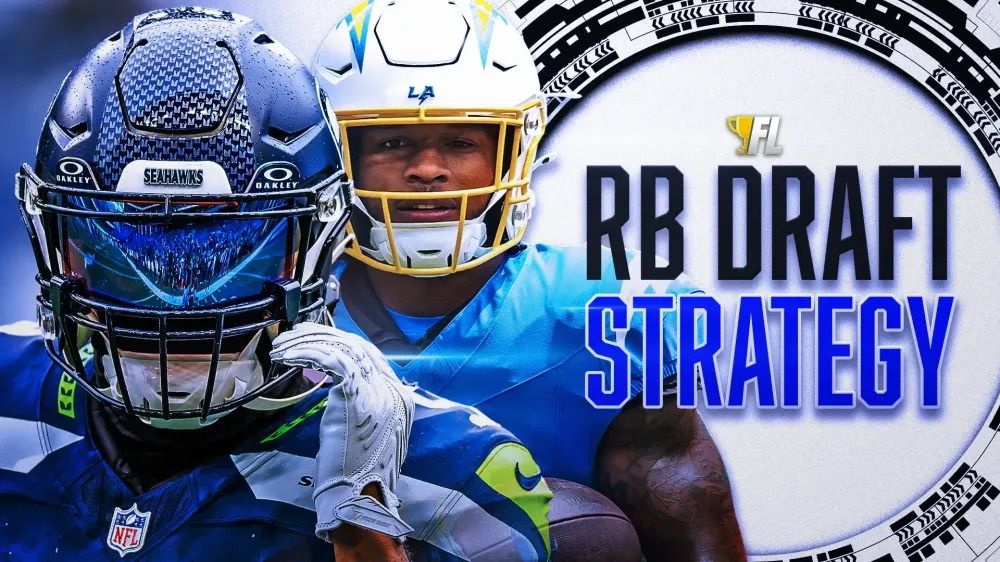
Running Back Draft Strategy For 2025 Fantasy Football: Omarion Hampton, Chase Brown, Bucky Irving, And More League-Winning Options
Dwain McFarland delves into varied draft strategies that fantasy football managers can employ at the running back position, going in ranges for each draft.
When developing a strategy for drafting fantasy football teams, there are three key questions to ask yourself:
- Positional supply and demand: How many do I need, and how many are available? League scoring and starting roster requirements are considerable factors that many fantasy players don't consider.
- Value: Can I target mispriced assets that offer similar value at this position later? The more confidence we have in this answer, the more we can consider not spending early picks on the position. These players become pillars within our strategy.
- Draft capital allocation: How much have I spent on this position? As a rule of thumb, the more we spend earlier in drafts, the less we will invest later, and vice versa.
Using these simple concepts, along with our rankings hub—which considers your custom scoring and roster settings—we can create an adaptable framework for drafting.
Every fantasy season, our strategy can differ depending on where positions and players go in drafts. Fortunately, we can access average draft position (ADP) data from all the major sites to help identify the positions where we are most comfortable waiting and which we need to attack early.
Today, we will analyze the 2025 RB landscape with these factors in mind to unveil the optimal draft strategy for the position. If you haven't checked out my RB Tiers, it contains crucial research that serves as the backbone for the 2025 strategy.
Of course, RB is just one of the positions! The strategies for QB and TE are already available, and WR will drop later this week.
Use the Code: DWAIN to get 20% off any Fantasy Life+ subscription.

Running Back Supply and Demand in Fantasy Football
Starting lineup requirements
Most fantasy leagues require two starting RBs and a flex position. That means in a 12-team league, there will be 24 starters, and roughly half of the flex spots will be filled by RBs, totaling 30 starters. This makes RBs a high-demand position on par with WRs in leagues that start with two WRs. In leagues that start 3 WRs and a flex, the WR position moves ahead.
Every additional flex spot in your league should push RBs and WRs up your draft board, as the supply and demand dynamics change.
Volume is KING
At WR and TE, playing time doesn't guarantee fantasy points because target-earning (talent) is a prerequisite to opportunity. However, talent is a less significant driver at the RB position. Even inefficient backs can rack up fantasy points if given enough touches.
Think about it. Once a back is handed the ball, nine other players (typically excluding the QB) are doing a job to help the RB gain yards. A running back doesn't have to get open and make a tough catch to score fantasy points. Because of this dynamic, it is easier to find strong fantasy producers on the waiver wire at RB than at WR or TE.
This doesn't mean we don't want efficient backs, but God only made so many players like Saquon Barkley, Jahmyr Gibbs, and Bijan Robinson. Explosive backs that can contribute in a big way in the passing game are among the most coveted possessions in fantasy football. We want to roster them every chance because they can almost single-handedly win your league.
Strategy bonus: because backup RBs suddenly in a starting role are more likely to produce fantasy points than backup WRs entering the lineup, we can build SUPER TEAMS by cornering the market at WR and aggressively attacking the waiver wire at RB.
Running Back Historical Scoring
When your alpha RB runs pure, there is nothing better in fantasy land.
Since 2011, RBs have led the top three finishers in points per game (PPG) with a minimum of eight games played versus other flex-eligible positions (WRs and TEs):
- PPR: 57% of the top-three finishes (43% for WR)
- Half-PPR: 76% of the top-three finishes (24% for WR)
- Standard: 95% of the top-three finishes (5% for WR)
In PPR formats, the RBs hold a slight edge when they run pure versus the WRs. However, in half-PPR and Standard leagues, RBs have a clear advantage when it comes to league-winning upside.

After the difference makers at RB are off the board, pivoting to focus on WRs makes a lot of sense in PPR and half-PPR formats based on historical scoring trends and the ADP values in 2025. I want my flex position to be a WR to start the season.
Similar to last year, I prefer the Hero RB strategy (take one RB in the first three rounds). But it can get tricky depending on your draft position if you take an RB with one of your first three picks, because there is a tier break at WR before your next pick. Last year, we had names like Nico Collins and Drake London at the 2-3 turn. That isn't the case in 2025.
Note: Early RB strategies come with risk because coaches are notorious for tinkering with situational roles at the RB position. It is an unknown we don't have to worry about with elite WRs. No one expected Arthur Smith to limit his No. 8 draft pick at a position with a limited shelf life to 45% of the rushing attempts, but he did. I love Jahmyr Gibbs and think his workload expands, but we could see David Montgomery back in the same role.
There are some sweet spots to target RB values throughout the draft that we can implement into our plan. Of course, we MUST understand the late-round RB landscape. Who are the stash plays who might walk into some SWEET volume based on injuries or lousy play by teammates that catapult them to high-end fantasy standing?
RB Strategy Walkthrough
Rounds 1 to 3: Strategy Summary
It is always important to consider your draft position for this sort of exercise. While I won't do this for all the rounds, it's essential to think through for all of your picks.
In the first three rounds, it is critically important because there is a tier break at WR before your second selection from an early position. Yet, the RB tier is longer and flatter.
Due to that dynamic, in PPR and half-PPR formats, I like Ja'Marr Chase and CeeDee Lamb in the first three picks. If it is a league that starts three WRs, I am almost certainly taking one of those two players.
An easy way to do this is to think through your 2v2s. Do you prefer a start of Lamb and Bucky Irving/Chase Brown, or do you prefer Bijan Robinson and Ladd McConkey?
- Early Position—Picks 1 to 4: Lamb/Brown vs. Bijan/McConkey; and if you miss McConkey, are you OK with Tee Higgins/ Tyreek Hill? Going Lamb, you have a good shot at Brown and Irving with Omarion Hampton as a backup plan.
- Middle Position—Picks 5 to 8: Christian McCaffrey/Drake London vs. Lamb/Irving?
- Late Position—Picks 9 to 12: Derrick Henry/Brian Thomas Jr. vs. Malik Nabers/Achane?
Rounds 1 to 3: Strategy Pillars
I don't have fades on any of the Round 1 RBs this year based on consensus ADP. That means they are all fair game based on who you like, if that is the direction you want to go in 2025.

So, let's focus on my strategy pillars in Rounds 2 and 3. Remember to fine-tune your draft strategy by sorting on the platform where you draft in our ADP tool.
 De'Von Achane | Dolphins
- Consensus ADP: 14 (Early Round 2)
- Age: 23.9 (Prime)
- Fantasy points per game (PPG): 16.6, 17.6
The third-year back is a menace in the passing game and can hit home runs from anywhere on the field. In games with Tua Tagovailoa under center, he averaged 22.6 PPG.
He improved in every utilization facet in 2024:
- Snaps: 42% → 62%
- Attempts: 34% → 48%
- Attempts inside the 5-yard line: 23% → 70%
- Routes: 45% → 61%
- Targets: 11% → 15%
The health of Tagovailoa and a bad run-blocking line are the two most significant challenges facing Achane. His passing-down prowess protects him from many bad runouts, but if you are leery of the line and Tagovailoa, take an RB in Round 1 and go WR in Round 2 rather than Achane.
Achane is the only RB I have graded in Tier 2 that makes it to Round 2. If he runs pure, he has the skill set to finish as the RB overall.
 Bucky Irving | Buccaneers
- Consensus ADP: 22 (Late Round 2)
- Age: 23.1 (Prime)
- Fantasy PPG: 14.2
While 14.2 PPG is a nice mark for a rookie Round 4 NFL Draft pick, Irving was even more impressive down the stretch. He took over the starting role after the Week 11 bye and went bonkers in seven healthy games through the Wild Card game.
- PPG: 19.3
- Snaps: 62%
- Attempts: 60%
- Attempts inside the 5-yard line: 100%
- Routes: 45%
- Targets: 11%
Irving is an electric playmaker.
- 10+ yard attempts: 13% (high-end RB1 worthy)
- Yards per attempt: 5.4 (high-end RB1 worthy)
- Yards after contact per attempt: 4.0 (high-end RB1 worthy)
- Missed tackles forced per attempt: 0.28 (high-end RB1 worthy)
We shouldn't count out a larger role for the second-year player in the passing game. First of all, he is good at it. His 21% targets per route run (TPRR) were higher than Rachaad White's (18%). Secondly, White suffered a groin injury in the first preseason game, putting his early season in jeopardy.
Let's not make the same mistake so many did with Achane last year, viewing a player's role as static. Everyone believed that Achane would never take over short-yardage work, but then he did.
Irving is the headliner of Tier 3, and I strongly considered adding him to Tier 2. He is the type of talent in a high-quality offense where I want to get my chips in the middle of the table.
 Chase Brown | Bengals
- Consensus ADP: 26 (Early Round 3)
- Age: 24.8 (Prime)
- Fantasy PPG: 15.9
Brown didn't take over the lead role for Cincinnati until Week 9 in 2024. Over the next eight healthy games, he held the No. 1 Utilization Score (95 out of 100), averaging 20.9 PPG.

On a high-powered offense without much competition for touches, Brown finds himself in a good situation.
We can expect Samaje Perine to take over the long-down-distance (LDD) work, but he could also threaten for two-minute snaps. The Bengals are a pass-first offense with one of the worst offensive lines. A route participation above 50% insulates Brown and boosts his ceiling.
I was on the borderline with Brown when I wrote up my tiers, given his average talent profile. But his 73% snap share and 60% route participation rate with the starters in Week 1 of the preseason are a reminder of how much he could dominate this backfield.
In the end, I asked myself: Am I really going to allow Samaje Perine to keep me from drafting Chase Brown? The answer is no.
Joe Mixon battled efficiency woes and shared passing-down work most of his career with the Bengals. He still fared well in fantasy.
- 2020: 85 Utilization Score (5th), 45% routes (16th), 16.9 PPG (8th)
- 2021: 85 Utilization Score (6th), 51% routes (11th), 17.7 PPG (6th)
- 2022: 82 Utilization Score (7th), 46% routes (17th), 16.2 PPG (7th)
- 2023: 82 Utilization Score (9th), 54% routes (11th), 15.6 PPG (13th)
As the 12th RB off the board in drafts, Brown has a good shot to pay off his ADP even if he loses some pass-down snaps. If his routes remain in the 60-to-65% range, he offers high-end RB1 upside.
Rounds 4 to 6: Strategy Summary
Guidelines for this section of the draft, depending on how many backs you already have on your roster heading into Round 4:
- Three: draft zero RBs; attack WR
- Two: draft zero to one RB; snag Jalen Hurts or George Kittle if they fall; attack WR
- One: draft a minimum of one RB and a maximum of three
- Zero: draft a minimum of one RB, but two to three is optimal
I prefer having a minimum of two RBs on my roster by the end of Round 6 in most formats this season. It still leaves a ton of flexibility while making sure to inject life into our fantasy backfield. All of these builds are possible through six picks with this rule:
- 1 QB (elite), 2 RB, 2 WR, 1 TE (elite)
- 2 RB, 3 WR, 1 TE or QB (elite)
- 2 RB, 4 WR (potential option in three-WR or two-flex leagues)
 Omarion Hampton | Chargers
- Consensus ADP: 42 (Round 4)
- Age: 22.5 (Pre Prime)
Hampton profiles closer to Jonathan Taylor and Josh Jacobs than the backs he goes around like Chuba Hubbard and James Conner. Not to say those guys are chopped liver, but the ceiling outcome for Hampton is on another level.
He was on a massive heater, climbing rankings and ADP, but the season-ending injury to RT Rashawn Slater has slowed things down. While the loss of Slater isn't ideal, Hampton still has the skill set to thrive in a run-balanced offense. He earned a 79 rating in the Rookie Super Model. Historically, 73% of similar backs have delivered a top-12 finish by Year 3.
With Najee Harris still not practicing due to an eye injury, Hampton is on a fast track to fantasy stardom. He has a legit shot at a top-12 finish this year, and you can draft him in Round 4.
Hampton is a target in late Round 3 to the middle of Round 4 in drafts.
 Kenneth Walker III | Seahawks
- Consensus ADP: 42 (Round 4)
- Age: 24.9 (Prime)
- Fantasy PPG: 16.5
Walker reached a career-high 16.5 PPG last year. He expanded his role in the passing game to take over the two-minute offense (69%) snaps and upped his route participation from 36% to 49%. His 14% target share was in RB1 territory.
Klint Kubiak takes over as offensive coordinator. He ran outside zone the third-most last season (46%), which is an excellent fit for Walker's jump-cut ability. Walker's explosive rush rate (8%) was down last year, but was at 13% and 11% the two years before. Zach Charbonnet is a formidable No. 2, but hasn't been able to unseat Walker in two years.
Walker is one of the few backs who has demonstrated the ability to dominate a rushing workload—including the high-leverage touches inside the 5-yard line—and remain involved in the passing attack.
 TreVeyon Henderson | Patriots
- Consensus ADP: 64 (Round 6)
- Age: 22 (Pre prime)
If you are looking for an infusion of upside in Rounds 5 to 6 at the RB position, Henderson is your man. The Patriots are lacking explosive playmakers, which could make Henderson a primary focal point of the offense.
He busted 17% of his attempts for 10+ yards at Ohio State and demonstrated skills as a receiver and pass blocker. In the first preseason game, Henderson notched a whopping 60% target share with the starters on a 75% route participation. This could be an Alvin Kamara sort of rookie season—limited attempts, but a massive mismatch in the receiving game.
If Henderson wrangles away around half of the early-down work from Rhamondre Stevenson, he will offer top-12 upside. He doesn't need a monster workload to pay off.
Henderson is my RB17 and offers RB1 upside if he surprises with a larger workload. Don't be afraid to reach a little if you started heavy at WR and need an RB2 with knockout punch power.
Honorable Mentions:
- Breece Hall | Jets | Round 4: Breece Hall offers the dual-threat skillset that unlocks massive fantasy upside, and he is only 24.

However, recent coach speak and preseason utilization point toward a potential three-headed committee. Drafters have paired that uncertainty and a bearish view on the Jets offense as a whole, leading to a drop in ADP. Hall falls into Round 4 on some platforms. I am buying the price dip based on his talent, but the cost is just steep enough that I couldn't make Hall a strategy pillar. That makes it more of a personal call for you.
- RJ Harvey | Broncos | Round 6: Sean Payton and the Broncos selected RJ Harvey a round ahead of where pre-draft mocks had him. He offers a unique blend of elusiveness and explosiveness. Harvey boasts a 31% missed tackles forced rate (73rd percentile) and an explosive rush rate (10+ yards) of 21% (75th percentile). Harvey started the first preseason game over J.K. Dobbins, but reports have surfaced that might have been due to a misplaced helmet by Dobbins. Harvey played OK, but often opted for the corner store rather than taking yards inside. That could keep the door open for Dobbins to carve out significant work. Still, Harvey has the skill set we desire behind a powerful offensive line in a scheme that maximizes backs in the receiving game. If you miss out on Henderson, Harvey is an excellent backup plan if you are looking for RB upside in the middle of your draft.
Rounds 7 to 9: Strategy Pillars
Guidelines for this section of the draft, depending on how many backs you already have on your roster heading into Round 7:
- Four: don't draft another RB; attack your positions of weakness
- Three: draft a minimum of one RB and a maximum of two
- Two: draft a minimum of one RB and a maximum of two
- One: draft a minimum of two RBs and a maximum of three
- Zero: draft three RBs
This stretch of the draft is littered with RBs from ambiguous backfields. All these players should be in a timeshare at minimum, but some will emerge as the lead options. While we don't know which is which, we want to embrace the uncertainty and attack RBs in these rounds, especially if we went heavy on WRs early.
Most of this group offers us RB3 value out of the gate with a chance to improve to RB2 status as the committee leader. With a teammate injury, some of these names will ascend to RB1 territory.
 Isiah Pacheco | Chiefs
- Consensus ADP: 73 (Early Round 7)
- Age: 26 (Prime)
- Fantasy PPG: 16.0 (as starter), 16.5
Over the last two seasons, when healthy, we have seen Andy Reid turn over the backfield almost entirely to Isiah Pacheco. He handled 67% of snaps and 75% of attempts in 2023 after taking over as the starter in Week 4. In two games before injury in 2024, he notched an 87 Utilization Score with a 74% snap share. He bogarted 74% of attempts and notched a 63% route participation.
I have softened a tad on Pacheco due to camp reports, but ultimately, we should not be that worried about Kareem Hunt (washed), Elijah Mitchell (often injured), and Brashard Smith (Round 7 pick). In most worlds, that is a good runout.
Pacheco is a cheaper version of Chuba Hubbard, James Conner, and D'Andre Swift, who you can draft one to three rounds later.
 Jaylen Warren | Steelers
- Consensus ADP: 95 (Round 8)
- Age: 26 (Prime)
- Fantasy PPG: 8.2, 11.5
Jaylen Warren handled 45% of the snaps in his healthy games in 2024 and will now battle rookie Kaleb Johnson instead of Najee Harris for work. Over the last two seasons, Warren has reached a 30% rush share 14 times (38% average). In those games, he scored 13.4 PPG.
It's hard to imagine a scenario where Warren gets the ball less with Harris gone. Johnson is a solid prospect, but the team doesn't have Round 1 draft capital tied up. Warren is going to make the youngster earn his touches.
Warren had a 12% explosive rush rate last year, battling injuries. The year before, he was at 16%. He has also been a plus in the passing game, with 1.45 and 1.44 YPRR marks. Warren will share time with Johnson, but he could make a push for the most significant role of his career.
I get it. You don't like Arthur Smith's track record of player utilization. Me neither—it's pretty silly. The good news: we don't need Warren to get 60% of the attempts. A 45% share might be enough with his receiving chops.
Warren is a midrange RB3 with the skill set to make an RB2 push if he leads the team in rushing.
 Jordan Mason | Vikings
- Consensus ADP: 107 (Round 9)
- Age: 26 (Prime)
- Fantasy PPG: 16.8 (healthy games starting for Christian McCaffrey)
The Vikings traded away a fifth-round NFL draft pick and swapped sixth-rounders to acquire Jordan Mason. Filling in for McCaffrey with the 49ers, Mason averaged 16.8 PPG over the first five weeks before suffering a shoulder injury.
The 26-year-old has a lot of outs in a high-quality offense behind a good offensive line.
- Mason could take over the lead role.
- Mason could force a 1A/1B split.
- Mason could remain the RB2 but get the majority of work inside the 5-yard line.
- Jones could miss time, opening the door for a massive role.
Mason is a midrange RB3 with RB2 upside.
Honorable Mentions:
- Tony Pollard | Titans | Round 7: I am not a huge Tony Pollard fan at this point in his career. However, he worked ahead of Tyjae Spears with the starters in Week 1 of the preseason, which matches the utilization we saw for stretches last season. Now Spears is dealing with a high-ankle sprain, putting Week 1 in jeopardy. Before Spears' injury, he was my favorite back to target in this backfield, but some backs aren't right all season after that injury. That opens the door for at least a prominent early-season role for Pollard. The veteran back pairs well with younger investments who could take time to get going in 2025.
- Kaleb Johnson | Steelers | Round 7: Kaleb Johnson doesn't offer the type of profile I typically want to target (not explosive and not a good receiver), but he plays on an offense that values bigger backs. While I love Warren, there is a world where Johnson returns a significant profit as a Round 7 pick. It's hard to find rookies with a path to snaps and his draft capital that late. Johnson is a nice upside swing if you went with veterans early.
- J.K. Dobbins | Broncos | Round 9: If Harvey struggles with negative plays, J.K. Dobbins could play a significant role behind a good offensive line in a scheme that features backs in the passing attack. Dobbins averaged 4.6 yards per tote last year and busted 14% of his attempts for 10+ yards. Dobbins is an RB4 with RB2 upside.
Rounds 10+: Strategy Summary
Guidelines for this section of the draft, depending on how many backs you already have on your roster heading into Round 10:
- Five: don't draft another RB
- Four: draft a minimum of zero and a maximum of two, depending on how early you took your other four backs (i.e., if they were all by Round 6, you don't have to take any more)
- Three: draft a minimum of one and a maximum of three, depending on how early you took your other three backs
- Two: draft a minimum of two and a maximum of four, depending on how early you took your other backs and how many picks you have left
Below, I have further broken these backs into buckets so you can attack the appropriate players based on your roster needs. I have bolded my favorites from each group.
Rounds 10+: Targets
Committee backs that could surprise as the team's clear-cut RB1 in Week 1:
- Dylan Sampson | Browns
- Jaydon Blue | Cowboys
Sneaky chance to have a more prominent role in Week 1 than we think or offer passing-down chops:
- Cam Skattebo | Giants
- Tank Bigsby | Jaguars
- Bhayshul Tuten | Jaguars
Backs who can provide early-season points but could fade as the season progresses. Draft these players if you have early-season concerns at your RB2.
- Jerome Ford | Browns
- Rhamondre Stevenson | Patriots
Handcuff options with little competition. Draft these options if you like your starters but want pure, unadulterated upside.
- Zach Charbonnet | Seahawks
- Trey Benson | Cardinals
- Ray Davis | Bills
- Tyler Allgeier | Falcons
- Jaylen Wright | Dolphins
- Isaac Guerendo | 49ers (injured)
- Will Shipley | Eagles
- Tahj Brooks | Bengals
Preseason vibes:
- Braelon Allen | Jets
- Jacory Croskey-Merritt | Commanders
- Keaton Mitchell | Ravens
- Blake Corum | Rams
- Kyle Monangai | Bears
Running Back Additional Strategy Guidelines
I have noted specific breakdowns in each RB section for 2WR leagues, but I will summarize them again here for ease of reference. Additionally, you will find 3WR league approaches.
Note: Always make adjustments based on the ADP using your league platform. The goal is to maximize your picks.
Two WR + Flex Leagues
Round-by-Round Guidelines
These bullets refer to how many RBs you should have rostered by the time you reach the final round in the range (i.e., by Round 6 in Rounds 4 to 6).
- Rounds 1 to 3: Minimum of zero RBs and a maximum of two rostered; one is optimal
- Rounds 4 to 6: Minimum of one RB and a maximum of three rostered; two to three is optimal
- Rounds 7 to 9: Minimum of two RBs and a maximum of four rostered; three is optimal
- Rounds 10+: Minimum of four RBs and a maximum of seven rostered
Additional Notes
- Remember, if you take fewer RBs early—let's say you have a minimum of two after seven rounds—attack the position more heavily in the following rounds and consider rostering as many as seven if you didn't take your first one until Round 5 or 6, since your other positions should be strong in this scenario.
- There is more value at WR in Rounds 9+on rookie WRs than you might be used to if you have drafted in best ball formats all summer (i.e., Matthew Golden, Emeka Egbuka, and Jayden Higgins). Keep this in mind when considering how you want to allocate your late-round capital. Do you want to be drafting J.K. Dobbins or Emeka Egbuka?
Three WR + Flex Leagues
Adding another starting WR pushes WRs up and other positions down in our draft plan. However, it impacts my RB approach less than TE and QB. So, the roster guidelines from above for RBs remain the same. However, I am more willing to embrace the minimums, and the optimals are less set in stone in each draft range, especially if WR values make it to me.
General Strategy Tips
- Monitor how your draft is going compared to the ADPs. If your leaguemates use sources other than the rankings and draft queue for the site, they could draft very differently.
- Pay attention to your opponents' needs between your pick and your following selection. For example, if it is Round 7 and they all have a QB, then you can take a calculated risk to pass on the QB to take another position, knowing they shouldn't draft two. One caveat to this rule: if the players behind you don't know what they are doing or are new to fantasy, don't assume they won't take the QB—they just don't know better.
- Pay attention to the names at the top of the draft queue by position. If there is a player you want and their name is near the top of the list in the draft room, don't be afraid to reach. When players are on the clock and unsure who to take, they often default to names at the top of the queue.
Practice, Practice, Practice. You can do this using the Draft Champion Mock Draft Simulator, presented by Gopuff. I just finished up a mock draft for an ESPN league where I started with CeeDee Lamb, and Nico Collins unexpectedly fell to me in Round 2.

Premium
Get $25 Guillotine League Credits When You Join FL+
Lorem ipsum dolor sit amet, consectetur adipiscing elit. Nunc tinciedunt, ex sit amet cursus gravida, dui mauris vulputate felis.