A New Data Point for Evaluating NFL Draft WR Prospects
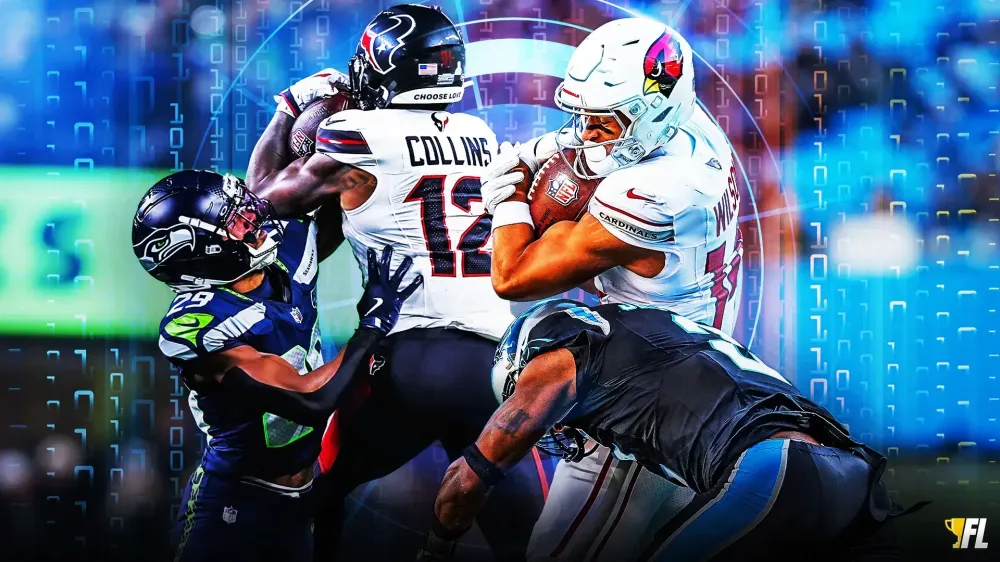
Dwain McFarland breaks down why career contested-target rate is a significant data point in evaluating WR prospects for the NFL draft and how it highlighted players like Nico Collins, Alec Pierce and Michael Wilson.
It's one of my favorite times of the year. It's officially NFL Draft SZN, y'all. That means I am deep in the weeds updating my prospect model: The Rookie Super Model.
Every year, I spend a significant portion of my time in late January and early February backtesting the models, adding another year of NFL data to see how well they performed. For the most part, the staples of the model aren't changing much at this point, maybe some tweaks here or there, such as normalizing data with additional context.
The part I find most personally rewarding is researching new variables to see whether they might add value to the model. I must confess that 99% of the time, these endeavors don't yield groundbreaking changes. Or I find something with a signal, but it is duplicative of a factor already in the model. Ultimately, we want to identify new factors that reveal something different about a prospect that the model isn't accounting for.
For wide receivers, there is one factor I have been monitoring for two years now but haven't felt we have enough data to call one way or the other: career contested-target rate (CCTR).
Pro Football Focus (PFF) started tracking contested targets for collegiate players in 2017. That means we didn't have a full career view of most college football players in the database until the completion of the 2020 season. While the sample is still small, we now have five draft classes (2021 through 2025) that allow us to backtest the CCTR against their production in an NFL season.
How predictive is career contested-target rate compared to other industry standards for NFL WR prospects?
Again, we are still dealing with a relatively small sample size, but early signs point toward CCTR as something we should consider to be a positive at the macro level for a WR draft prospect.
The correlation between CCTR and PPR fantasy points per game over a prospect's first three NFL seasons is 0.40. Of the 124 variables I have tested for WR prospects, that ranks 19th. On the surface, that might not sound like much, but it is well above many other factors that industry models rely on:
- Career receiving yards per team pass attempt (RYPTPA): 0.36 (23rd)
- Career yards per route run (YPRR): 0.35 (30th)
- Age: 0.33 (33rd)
- Career target share: 0.24 (57th)
- Athleticism: 0.19 (72nd)

Premium
Go FantasyLife+
Your league is unique. Your advice should be too. Get personalized tools, rankings, and projections tailored to your fantasy football league settings.
Is career contested-target rate telling us something new about NFL WR prospects?
After seeing the data above, my first question was: Does CCTR correlate strongly with other key factors within the WR Rookie Super Model? Is it really telling us something different about a prospect? From doing this type of research before, my gut said yes, but that mostly wasn't the case.
Below is how CCTR correlated with other components, ordered by how much weight each factor receives in the Rookie Super Model for WRs:
- NFL Draft Capital: -0.03
- NFL.com grades: -0.02
- Career adjusted RYPTA (accounts for age, teammates, schedule, etc.): -0.04
- Career target passer rating: -0.22
- Career target share: -0.01
- Program quality (FPI power index): -0.05
- Age: -0.04
Every factor except passer rating has a correlation of -0.05 or less. All of the negative correlations, although mostly slight, do create some concern about the value of contested targets. It isn't surprising to see that CCTR's strongest correlation is with career target passer rating given completions—a significant component of the calculation—go down on contested targets vs. non-contested opportunities.
Overall, these correlations are positive when assessing whether CCTR reveals a new aspect of a player's game. One way to think about it is whether we would include any factors in a model with correlations as low as the ones above, and the answer is mostly no. The only factor I have in the Rookie Super Model today with a correlation outside the range of -0.20 to +0.20 is athleticism, and it carries very little weight.
Which factors correlate highly with career contested-target rate?
The factors that correlate more strongly with CCTR are role- and situation-based.
- Wide alignment: 0.57
- Average depth of target (aDOT): 0.56
- Team completion rate: -0.25
These all make sense. Playing on the outside often results in matchups against the opposing team's better defensive backs. If the route concept keeps the receiver outside, then the pass must travel farther. The farther a pass must travel, the more QB accuracy drops, and the more time defenders have to react.
Of course, we see the same thing with aDOT. Additionally, the deeper the pass, the more likely the receiver is to be dealing with a combination of defenders, such as a cornerback and a safety.
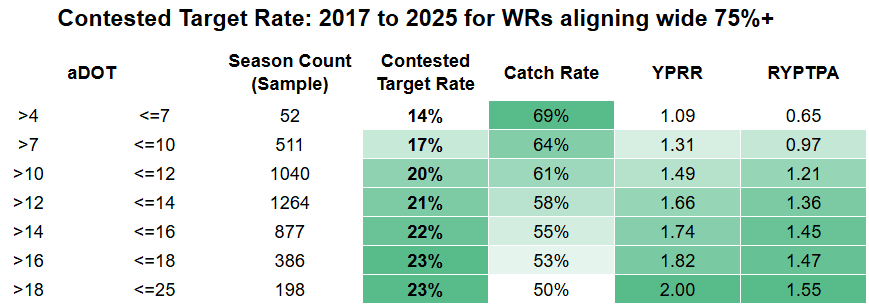
Below is a table illustrating the contested target rate by aDOT for WRs who aligned outside 75% or more of the time from 2017 to 2025. The data is based on season-level results. I have included overall catch rate, YPRR and RYPTPA for the nerds.
You can see how contested targets go up and catch rates come down based on aDOT.
Team completion rate isn't as strong as the other two factors, but I included it because it had the third-strongest signal. Additionally, it is logical that a receiver dealing with a less accurate passer will deal with more contested targets.
Note: I have adjusted career contested target rate data, but it is at the game level. At that level, it didn't provide any additional helpful context. We don't currently have access to the play-level data, which might unlock additional insights.
None of the three situational factors above carries a strong correlation to future fantasy points, but with the additional context of targets, they come to life. Collegiate receivers who can win on the outside beyond the short areas of the field are considerable assets to their team and are likely to deal with more contested targets.
Is there another key factor in play with contested targets?
There is another factor we can't measure in a spreadsheet or code that could be a major factor in CCTR: quarterbacks are willing to throw to their best players even when covered.
Most of you have played football at some level, even if it was a pickup flag football game. If you have ever played quarterback, even at that level, you quickly understand who your best players are.
To test my hypothesis out, I reached out to Matt Waldman, the author of the Rookie Scouting Portfolio. Matt has been evaluating players using a data-driven film approach over the past 20 years. He is highly transparent about his process, including which traits are the most important for each position. The RSP also highlights which aspects are the easiest and hardest to fix based on extensive film study.
To start our conversation, I didn't share my hypothesis. I just shared the data around CCTR and asked for his thoughts. He immediately referenced the word trust. Good receivers are likely to receive more attention from the defense (and play roles that dictate more coverage), but QBs often still consider them the best option because they trust them to make the play.
I also reached out to our own Matthew Freedman with the same data. While Freedman doesn't grind film in the same way Waldman does, he has a long history in this space and is good with models and is just overall an intelligent person (the best NFL mock drafter on the planet since 2020, in case you haven't heard). His first reaction was the QB trust factor.
While we don't have hard data to prove this point, it is logical that a portion of the signal we are getting from contested targets comes from QB intent. They intend to target their best players—the ones they trust to make plays.
How have the top contested target rate players performed?
Now that we have discussed the macro signal and some of the factors at play with CCTR, let's put some names to these players.
Below, I have highlighted players drafted in the first three rounds of the NFL Draft since 2021 who had a 70th percentile or higher mark in CCTR. For each player, you can see the percentage of targets that were contested, plus the additional context of contested catch rate, aDOT, wide alignment, NFL Draft round and the player's best PPR points per game season finish.
Since NFL Draft Capital is the best predictor of future success in the NFL, the players are ordered in buckets by draft round.
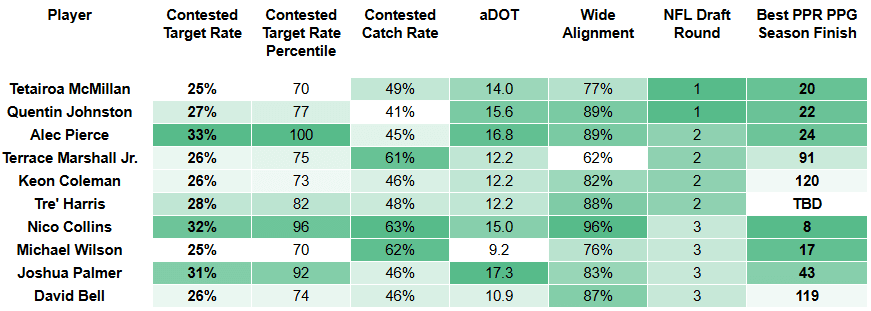
If we summarize this data by draft round, below are the hit rates on a top-24 finish for high CCTR players. I have also included historical top-24 hit rates from 2018 to 2025 for all WRs drafted in those rounds as a comparison.
- Round 1: 100% (2 of 2); 53% (out of 36)
- Round 2: 25% (1 of 4); 24% (out of 45)
- Round 3: 50% (2 of 4); 16% (out of 31)
It's important to remember that we are still reacting to a small data set, and we can't use it to extrapolate into the future. But this is encouraging stuff. To this point, high CCTR prospects have performed well after normalizing for draft round.
Nico Collins boasted the strongest combination of CCTR and contested catch group and has by far been the best performer of the group. Collins broke out in his third season with 17.2 PPG and followed that up with 17.6 and 15.1. Despite his deep aDOT, the delta between his career RYPTPA and first downs per route run (FDRR) was neutral, indicating he wasn't completely reliant on big plays.
The players with an aDOT of 14 yards or higher outperformed players with lower aDOTs, except Michael Wilson (9.2-yard aDOT), who broke out in 2025 with Marvin Harrison Jr. in and out of the lineup with injuries. However, Wilson was elite in contested catch rate at 62%. The average for NFL combine prospects since 2021 is 46%.
Terrace Marshall Jr. also boasted a strong contested catch rate of 61%, but he had a 12.2-yard aDOT and operated outside the least. It is hard to say whether any of these components will hold up in a larger sample, but as we get more data, we can further refine how we assess the value of contested targets based on aDOT and alignment.
For now, I will give CCTR a small weight in the Rookie Super Model in 2026 and re-evaluate in 2027 after another year of data. The model for the 2026 class will drop after we get NFL Combine results, but you can see all of my notes about the model and the 2025 class here for free.

Join Our Newsletter
Trusted by 400,000+ fantasy football players. Get access to Fantasy Life's free award winning newsletter and tools, all in one step.
By registering or logging in, you agree to our Terms of Use and Privacy Policy.