
How Does Age Impact WR Performance in Fantasy Football?
Dwain McFarland examines when wide receivers are at their prime, when they start to decline and ultimately when they fall off — and applies the results for 2024 fantasy drafts.
We are living in the WR era.
Every year, WRs are going earlier and earlier in fantasy drafts. The top 36 WRs are going 6.2 picks sooner than last year on Underdog.
While best ball has been the sparkplug igniting the meteoric rise of WRs, the phenomenon is spreading to other formats. In high-stakes drafts over at the FFPC, the WR36 is coming off the board by pick 74 — only six spots later than Underdog.
As a result of this trend, the strategy for selecting WRs has become more critical than ever. It's not just about choosing the best WRs and avoiding the underperformers. There are also significant opportunity costs to consider when compared to other positions. For instance, some fantasy football enthusiasts are opting for WRs like Cooper Kupp and Stefon Diggs over elite QBs such as Josh Allen, Jalen Hurts and Lamar Jackson.
I intentionally brought up Kupp and Diggs because they are two of seven WRs with at least four WR1 finishes on their resume that will be heading into their age 30-season or older. We have a lot of high-end WRs getting up there in age in 2024.
Given all of these factors, I decided to investigate the impact of WR age on fantasy performance.
This article will outline when WRs are at their prime, when they start to decline and ultimately when they fall off. Additionally, we will identify critical criteria that can help us discern which aging WRs might still have more to offer versus who we need to avoid. Finally, we will apply everything we learn to the aging WRs for the 2024 season.

Premium
Get $25 Guillotine League Credits When You Join FL+
Lorem ipsum dolor sit amet, consectetur adipiscing elit. Nunc tinciedunt, ex sit amet cursus gravida, dui mauris vulputate felis.
How does age impact wide receiver performance in fantasy football?
To appropriately understand the magnitude of age in the WR performance equation, I decided to divide production at each age (20 to 40) by their prime production. Prime production equals the average fantasy points per game for a player's best three-year stretch in their career, and player ages were rounded based on their age on Week 1 for each season.
After compiling that data across every season where a WR had at least 200 routes from 2011 to 2023, we get a clear picture of when WRs are at their peak and when they begin to decline. For the sake of simplicity, buckets were created for age groups based on performance.
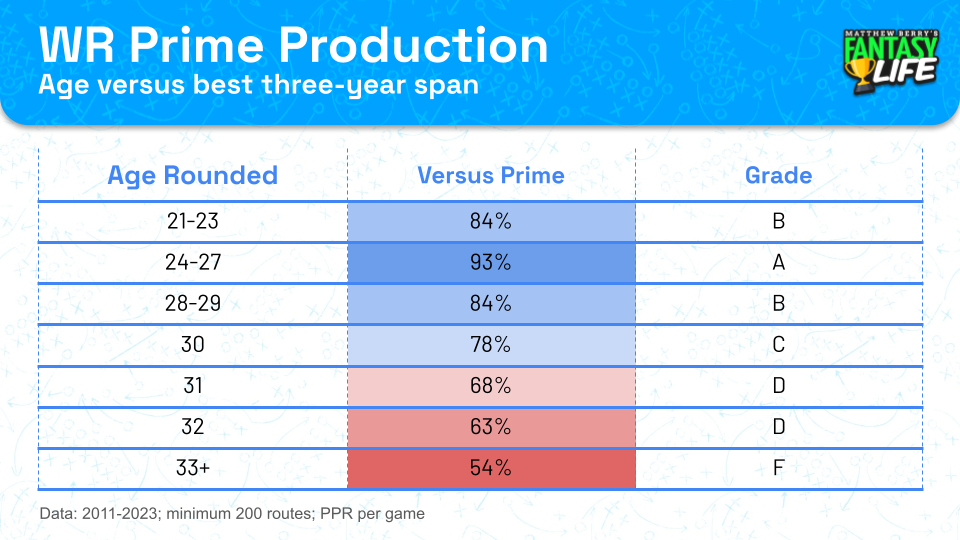
Data summary (remember ages are rounded):
- Ages 24 to 27 represent the typical prime years for WRs — we should aggressively draft ascending or elite WRs entering this range.
- Ages 21 to 23 and 28 to 29 have performed similarly. While younger WRs are often getting up to speed before their peak, their older counterparts have the savvy to remain relevant, albeit not as good as they once were.
- At age 30, WRs can still be productive, but the data dips below their early years as age starts to catch up.
- Age 31+ represents seasons where average production dips 30% to 40% below prime years. Depending on the players' peak numbers, that might still be a usable season, but we can't assume that WRs in this range will keep on keeping on — we must be vigilant.
Of course, as WRs age the risk of reduced production isn't the only factor at play. We must also consider how likely they are to reach a point where they are no longer viable options for our fantasy lineups. They could hit the dreaded cliff.
When do WRs typically hit the age cliff?
For this phase of the research, we will define a cliff season as one where the player falls below WR3 status (12 PPR points per game). While this might sound aggressive, we aren't winning fantasy championships with WR3s, much less WR4s, in normal-size leagues with typical starting lineup requirements.
As I began working through this data, it became apparent that this research would need to be divided into subgroups. So, we will analyze two different WR types: elite and good.
- Elite WRs: delivered a minimum of three WR1 finishes during their career
- Good WRs: delivered at least three top-24 finishes but less than three WR1 campaigns
Elite WR performance and age cliffs
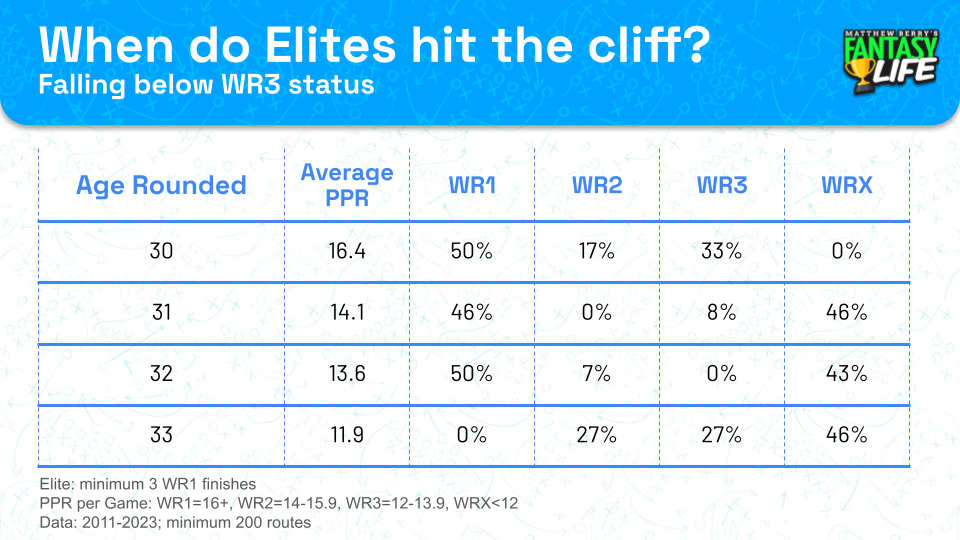
Data summary:
- While WRs begin to decline at age 30, elite WRs have fared well, averaging 16.4 points per game — above the WR1 threshold. Since 2011, none posted a cliff year (WRX), and half retained WR1 status.
- At ages 31 and 32, the upside for a WR1 season is still there, with roughly half remaining above 16 points per game. On average, they performed more like borderline WR2s, and the risk of running into a cliff season neared 50%.
- The floor and ceiling declined for age-33 WRs. Cliff rates were nearly identical to those for ages 31 to 32, but WR1 performances plummeted to 0%.
Good WR performance and age cliffs
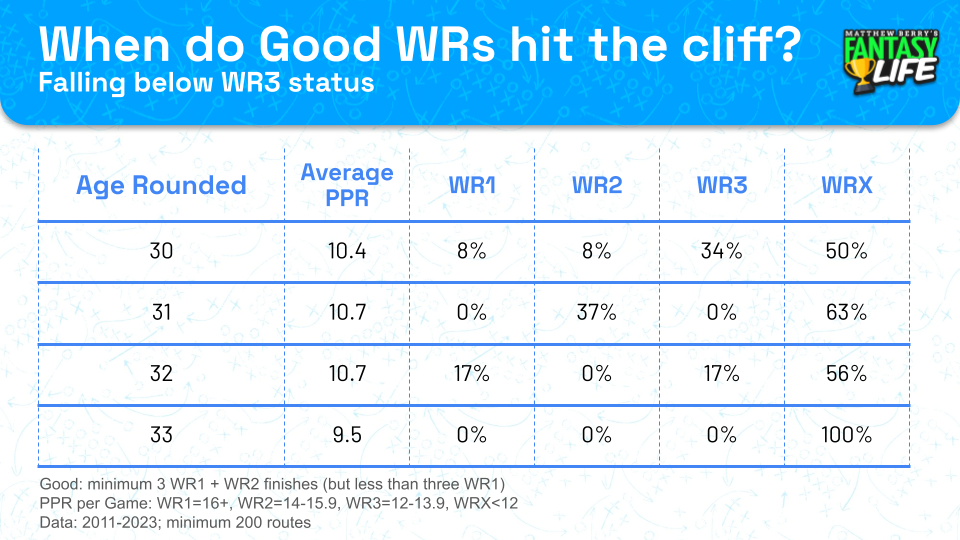
Data Summary:
- Good WRs didn't fair as well in their prime performance peak, meaning they had less buffer between them and a WR4 finish. Overall, this group was a coin-flip or worse to run into a cliff season across all age groups.
- From a cliff-avoidance perspective, age 30 was the safest year, but the upside for a WR1 or WR2 finish wasn't substantial.
- Aging WRs from the good subgroup performed more like borderline WR3s on average.
Can we predict the downfall of aging WRs?
OK, we understand the basic risk-reward profiles for aging WRs based on age and subgroup. But you are probably asking yourself: Are there other indicators that can help us better understand if the cliff is near?
And that is a great question, especially considering the near coin-flip odds we saw for elite WRs posting another WR1 finish versus a WR4 dud. If we find a way to de-risk some of the downside, those could become profitable profiles for us to target when ADP (average draft position) cooperates.
To answer this question, we need to know which data points are most predictive of future fantasy production. Of course, we will need to factor in age to get this right.
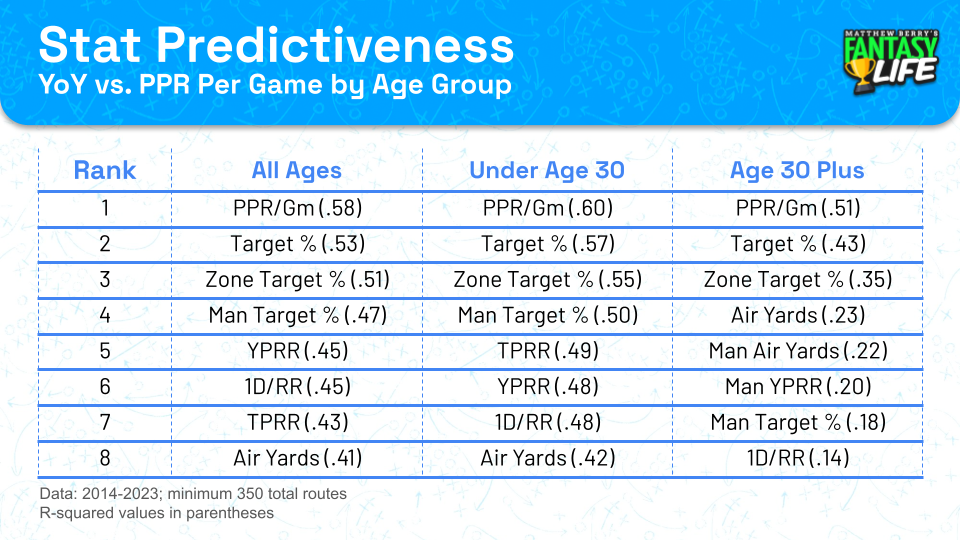
The minimum route thresholds were increased from 200 to 350 for this activity because I wanted to include man and zone splits based on a great thread from Jacob Gibbs a couple of weeks back that caught my attention.
While all the stats lose predictive power for age-30-plus WRs, it is interesting to note that air yards, man air yards and man YPRR climb into the top eight. We will get more into that in the section below as we analyze the aging 2024 WRs, but for now we will focus on the fact that PPR points per game were clearly the most predictive for future fantasy points from one season to the next.
With that in mind, I analyzed the data for points-per-game trends season over season. Based on the data, cliff-seasons were grouped into categories.
- No cliff: never fell below WR3 status
- Sudden: no signs of PPR decline ahead of sub-WR3 cliff
- Gradual: step-down production eventually falling below WR4 status
- Turbulence: up-and-down production ahead of sub-WR4 season
- Injury: injury season before decline
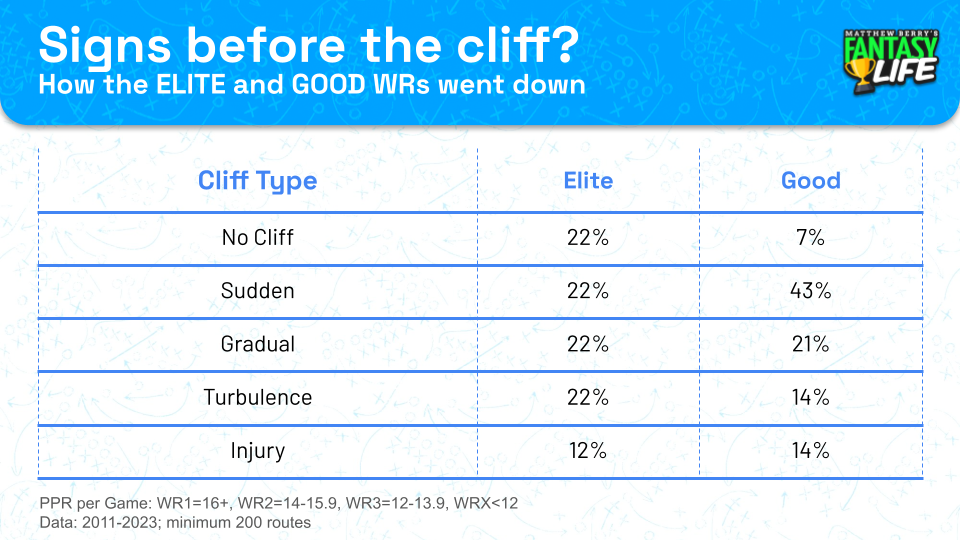
Data summary:
- Elite WRs were less likely to experience a sudden plunge into WR4 territory without warning. Of the elites who hit a cliff, 10 out of 14 came from the gradual, turbulence and injury buckets. That means 71% of the time, we had some form of a warning for the elites.
- For the elites, there was one instance of an age-30-plus WR falling below WR3 status and rebounding for a WR1 finish (Larry Fitzgerald). Roddy White climbed from a WR4 finish back to WR2 at age 33, and Anquan Boldin posted WR3, WR2 and WR3 finishes after a WR4 season at age 31. Rebounds can happen, but rarely do we see multiple WR1 finishes once a WR registers a sub-WR3 campaign after the age of 30.
- Good WRs fell into WR4 territory without warning (43%) almost twice as often as the elites, which makes sense considering they had less buffer between them and WR4 territory. Of the good WRs who hit a cliff, seven out of 13 had some form of PPR or injury warning.
- For the good WRs, only Emmanuel Sanders fell to WR4 status at age 29 or older and found his way back to another WR1 or WR2 finish. Rebounds were more rare for this group.
How should we handle aging WRs in 2024?
Now that we understand some of the warning signs, let's examine the aging WRs for the 2024 fantasy season. First, we will focus on PPR performance and trends and then supplement that with a look at air yards and man YPRR (yards per route run). We don't want to overstate the predictiveness of the man coverage splits given their low r-squared values, but they are still clues we can use for context.
Based on their current ADP on Underdog, I will share my current approach for each player. We will start with the elites (remember, ages are rounded based on Week 1).
Aging Elites in 2024

Davante Adams
Adams fell to 70% of his prime production in 2023, registering his first non-WR1 finish (15.6 PPG) for the first time since his third season. On a positive note, he still delivered a WR1-worthy 112 air yards per game. However, his YPRR against man has fallen in each of the last two seasons (3.04, 2.00, 1.66).
QB play is a factor for YPRR, but it is hard to get too excited about Aidan O'Connell and Gardner Minshew. Additionally, the Raiders added target competition by selecting Brock Bowers in Round 1 of the NFL Draft.
We can't rule out Adams' return to WR1 form, but right now he is a fade for me as the WR13 off the board.
Keenan Allen
Allen is coming off a seventh consecutive WR1 PPG season. He appeared to be slowing down in 2020 and 2021 with YPRRs of 1.91 and 1.78, but this was a false alarm. He rebounded with marks of 2.18 and 2.36 over the last two years, and his man YPRR was 2.14 last season.
He is definitely at the age where a sudden cliff could hit, and he will face stiffer target competition from D.J. Moore and Rome Odunze with a rookie QB in 2024. Injuries have also been a factor, with Allen missing 2, 1, 7 and 4 contests over the last four seasons.
Still, most of this is baked into his price as the WR33. I want to stay moderate with my exposure, but am willing to be even with the market.
DeAndre Hopkins
Hopkins has hit the turbulent era of his career. He has two WR3 finishes in his last three years — which hasn't been a kind trend to other aging elites. The veteran dominated air yards last season with a WR1-worthy 116 per game. His 2.00 YPRR versus man coverage remains respectable, but it is a far cry from his prime years when he averaged 2.54.
With the arrival of Calvin Ridley to challenge for targets, Hopkins will need a big step forward from Will Levis to rebound to WR1 status. However, Brian Callahan should run a more pass-friendly offense in 2024, and Hopkins isn't expensive (WR41).
I am willing to dabble with Hopkins, but his PPR turbulence is a major red flag, so I want to limit my exposure, especially if I selected any other aging WRs earlier in my draft.
Tyreek Hill
You don't need me to type many words about Hill. He has shown no signs of slowing down on the points-per-game front. Last year, he registered his best fantasy finish with 23.8 points per game and a dominant 3.82 YPRR against man coverage.
Hill is at the age where a sudden cliff could occur, but the history of that happening to elites is only 22%. I will take that risk, given his potential to finish as the hands-down WR1.
Mike Evans
Evans has experienced turbulence over the last four seasons, with two WR1 and two WR3 finishes. However, that has been his MO over his career (WR1, WR2, WR1, WR3, WR1, WR1, WR2, WR1, WR2, WR1) so I don't want to overreact.
Interestingly, Tom Brady's propensity to go away from Evans and his deeper routes against zone was the most significant factor in his two recent down years. His TPRR against zone was 16% and 19% during those seasons. Last year, with Baker Mayfield, that number was at 24% – closer to his career average. Evans remained a MONSTER against man coverage in 2023 with a whopping 3.37 YPRR.
Drafters are treating Evans as a mid-range WR2 (WR17), a price I am comfortable paying. There is a chance his recent ups and downs are a turbulence signal rather than an extension of his career MO, which is enough to keep me from wanting overexposure. Additionally, I am still uneasy about Mayfield, given his long-term track record.
Stefon Diggs
Diggs has delivered four consecutive WR1 finishes, but his ADP is falling. He will face more competition from younger targets like Nico Collins and Tank Dell, but there is a chance he is the guy to roster in an ascending passing attack with a big-time young quarterback.
The veteran WR's fantasy production faltered in the second half of 2023, averaging only 9.6 points per game, but he retained a 28% target share. However, the Bills' move to a run-first offense under Joe Brady, with a minus-3% DBOE (dropback rate over expected), was a significant factor.
Diggs' YPRR against man coverage dipped below 2.00 (1.88) for the second time in the last three seasons, which is a concern. However, the last time, he rebounded to 2.65 in 2022.
While Diggs' profile isn't perfect, his PPR per game numbers are strong, and his low-end WR2 price tag (WR22) is where I want exposure, slightly above or even with the market. I can't tell you who will lead this Texans passing attack, but I won't be surprised if it is Diggs, so I want shares of all the pieces.
Cooper Kupp
Kupp registered his first WR3 performance (13.5 PPG) performance since his rookie campaign. He was playing through injuries, which was a contributing factor. However, injuries have been one of the leading indicators for aging WRs ahead of the cliff, and Kupp has missed 13 games over the last two seasons.
With injuries in tow, Kupp's YPRR against man plummeted to 1.32 last season. That marks a second consecutive year of decline after dropping from 4.22 to 2.07 in 2022. Additionally, we have the emergence of Puka Nacua as a high-end WR1 option.
Kupp held his own against Nacua last season with a 27% target share in games together, so he could re-emerge as a high-end option. However, given all the warning signs, I am considering limiting my exposure slightly. That is something I had yet to do before this research.
Aging Good WRs in 2024
I am looking to limit my exposure to most of the wide receivers that fall into the good wide receiver subgroup. None of the price tags are terrible, but everyone except Amari Cooper has demonstrated warning signs.
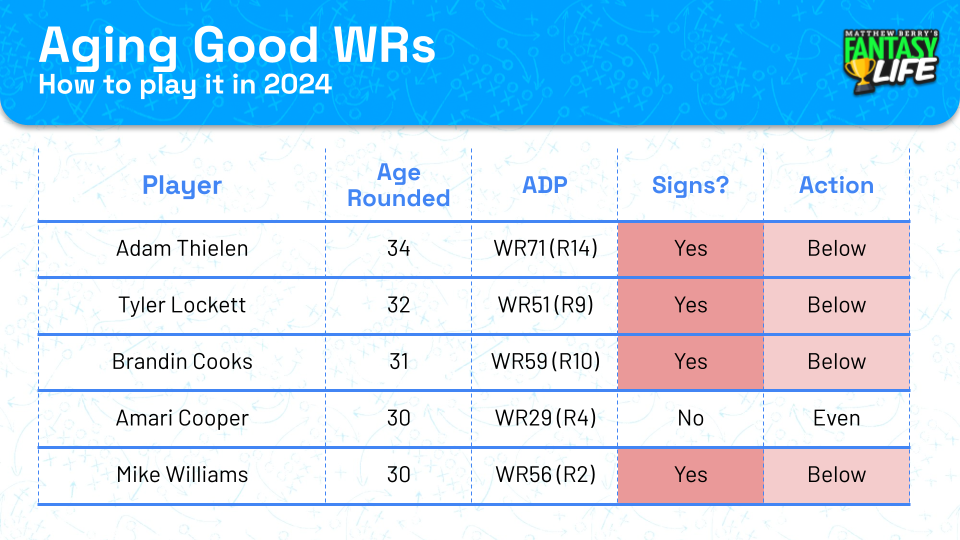
- Adam Thielen – Thielen is really old (34) and has reached the volatile stage of his career with WR2, WR4 and WR3 finishes. He could start hot again, making him a name I am willing to mix in depending on my build, but the Panthers are trying to go in a different direction with Diontae Johnson and Xavier Legette.
- Tyler Lockett – Lockett was one of my most drafted WRs in early drafts, but his rise up the board and this research have me headed in the opposite direction now. His WR4 finish last year doesn't bode well for the future, and his YPRR against man has fallen to 1.18 and 0.94 over the last two seasons. I might miss out on a WR3 or WR2 rebound season, but that isn't going to sink my fantasy campaign, and the cliff potential is high. Lockett is only a target in stacking situations, and this data also bodes well for Jaxon Smith-Njigba.
- Brandin Cooks – Cooks has had two WR4 finishes over the last two seasons, and his YPRR against man coverage is down (1.50 and 1.57). The Cowboys offense isn't going to change his ability suddenly — they needed more from Cooks last season, and he didn't deliver. I am only taking Cooks past ADP in stacks.
- Amari Cooper – Cooper has never cracked 16 points per game but has six WR2 finishes in nine seasons, including the last two years. The Browns added Jerry Jeudy to the fold and Deshaun Watson has been pretty awful, so Cooper has some WR3 downside, but not due to his ability. I am underweight on Cooper but am OK staying even with the field.
- Mike Williams – Williams is coming off of an ACL tear that limited him to three games last year. At age 30, it could take him some time to get up to speed in 2024, which is a red flag. However, his 3.70 YPRR man in 2022 was elite. I don't want to be overweight on Williams, but I am targeting him some on Jets builds and as a bring-back piece for matchups in Weeks 15 through 17 in best ball.