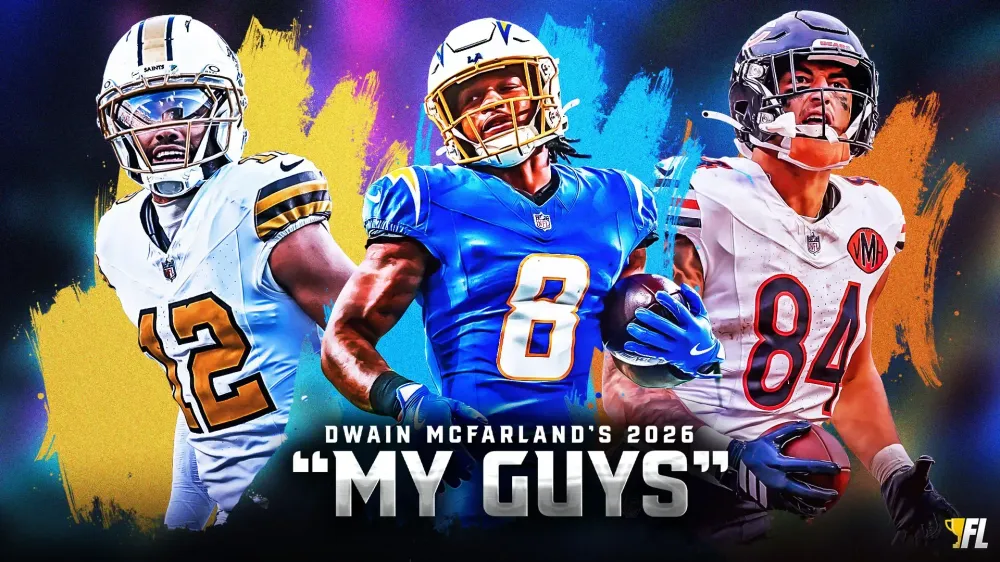
Fantasy Football 2026 My Guys: Targeting Joe Burrow, Omarion Hampton and Others in Early Drafts
Dwain McFarland produced his early 2026 Fantasy Football My Guys, featuring players like Joe Burrow and Omarion Hampton to target in early drafts.
It is really way too early for a 2026 My Guys list, but we are sick in the head like that over here at Fantasy Life. But rather than taking big stands on players, I will use early ADP data from Underdog Big Board drafts where over 450 drafts have already been completed. Talk about SICK IN THE HEAD—y'all are animals!!!
Based on early ADP, we will focus today on players I would be hard-pressed to pass on in fantasy drafts, given their potential value. For now, I am going to leave the rookies out—we have much more to come on that front in the coming weeks as I am in the Rookie Super Model lab!!!
Fantasy Football 2026 Early Favorite Picks, My Guys
Quarterbacks
The early QB landscape is very interesting, and my biggest takeaway is that there is value in waiting. Josh Allen is in a tier of his own, as the only QB going inside the first three rounds of early drafts as pick 26. Drake Maye, Lamar Jackson and Caleb Williams go in Rounds 4 and 5. The market loves Mike McDaniel in Los Angeles, pushing Justin Herbert up to QB5 status in Round 6.
While I like all of those names, we have a plethora of proven players and up-and-comers—including options with high-end dual-threat ability.
 Joe Burrow | Bengals
Joe Burrow suffered a turf toe injury in Week 2 that kept him out until Week 13. Upon his return, he averaged 20.6 points per game (PPG), making him the QB8 over the final six games. Burrow doesn't have the mobility of some of the players below, but he is an elite passer in an offense with plenty of weapons, and his track record when healthy is amazing.
- 2024: 23 PPG (third)
- 2022: 22.7 PPG (fourth)
The Bengals signal caller could easily outperform several names going ahead of him, but you can grab him as a Round 6-7 turn pick.
 Jaxson Dart | Giants
The rookie QB took over the starting gig in Week 4 and ranked second in designed rushing attempt rate (13%) and fourth in scramble rate (9%). He ranked second in designed rush attempts inside the five-yard line (33%). Jaxson Dart delivered 19.9 PPG, making him the QB8 over that span.
The Giants governed Dart's rushing a bit down the stretch after a concussion knocked him out of the Week 10 game against the Bears. His designed attempts fell to 7%, but his scramble rate held strong at 10%, and he still accounted for 25% of the attempts inside the 5.
We could see something similar in 2026, but we also have John Harbaugh arriving on the scene, and he knows a thing or two about maximizing a QB's rushing upside. The big takeaway here is that Dart was a QB1 as a rookie despite missing his top pass catcher, Malik Nabers.
Dart is a fun click in Round 7 of drafts.
 Jayden Daniels | Commanders
Jayden Daniels' 2025 season was marred by injuries, but he still possesses elite upside as a dual-threat QB, offering QB1 overall upside. It is hard to give you much analysis on a season where Daniels played 100% of the snaps in only two contests. However, he still posted an elite scramble rate of 18% and collected a healthy 9% rush share in games played.
Kliff Kingsbury is out in Washington, with David Blough moving up from assistant QBs coach to take over the offensive coordinator duties. The Commanders are getting long in the tooth at the WR and TE positions, which could put them in the running for a WR in the first round of the NFL Draft. In Matthew Freedman's latest mock draft, he has Carnell Tate, Jordyn Tyson, Makai Lemon, Denzel Boston and Kevin Concepcion all going in Round 1.
Just don't forget that Daniels averaged 21.1 PPG as a rookie. He could easily outperform his early-draft ADP of QB8 in Round 7.

Premium
Go FantasyLife+
Your league is unique. Your advice should be too. Get personalized tools, rankings, and projections tailored to your fantasy football league settings.
 Jalen Hurts | Eagles
The Eagles rightfully fired Kevin Patullo, who turned one of the strongest offensive rosters into the 23rd-ranked unit in passing yards per game with 194. After averaging 21+ PPG in four straight seasons, Jalen Hurts fell to 18.6 as the QB7 in 2026.
This one is pretty straightforward. Hurts has a longstanding history of fantasy success. He has delivered 10, 13, 15, 14 and 8 rushing TDs over the last five seasons. In 2022, he delivered a massive 25.6 PPG campaign.
Maybe drafters are betting on a tush-push banishment from the league? That, plus a trade of A.J. Brown, is what it would take for me to rank Hurts as the QB10, where he is going now.
Hurts is an appealing option in Round 8 of fantasy drafts. He still carries top-three upside.
 Trevor Lawrence | Jaguars
Trevor Lawrence clicked in Liam Coen's scheme over the second half of the year. From Week 12 through the Wild Card round, he averaged 25.4 PPG, making him the No. 1 QB in fantasy over that span. He accounted for 10% of the designed rush attempts and registered a 7% scramble rate, providing upside on the ground as well as through the air.
If you believe that the second half of 2026 is the new reality for Lawrence, then he makes for an interesting option in Round 8 of drafts.
Running Backs
The RB position has a lot of moving parts thanks to a strong class of free agents, including Breece Hall, Travis Etienne Jr., Kenneth Walker III, Javonte Williams and Tyler Allgeier. Additionally, Notre Dame's Jeremiyah Love projects as a Round 1 pick. I am not going to write up the implications of each player, but their landing spots will have a significant ripple effect across multiple teams. If you are drafting now, keep this in mind—diversification is key.
 Omarion Hampton | Chargers
Despite battling through injuries and massive offensive line issues, Omarion Hampton still averaged 14.9 PPG as a rookie. In five games where he handled 55% or more of the rushing attempts, he averaged 19 PPG. It is hard to imagine a world where Hampton doesn't see over 55% of the attempts next season, given the Chargers' Round 1 investment.
While the Chargers have a lot of mouths to feed in the passing game, it is worth noting that Hampton ranked 11th at the RB position with a 12% target share. He will never be an elite passing-down option, but the path is there for an every-down role.
With Mike McDaniel taking over the offensive coordinator position and a healthy offensive line, the Chargers could be one of the better offenses in 2026. With the evolution of NFL defenses, teams are running more, which is boosting the stock for good RBs.
Hampton offers high-end RB1 upside. He is one of my favorite Round 2 picks in early drafts.
 Ashton Jeanty | Raiders
Ashton Jeanty didn't have the rookie season many were hoping for as a Round 2 pick in 2025 fantasy drafts. However, massive changes are coming for the Raiders. Pete Carroll is out, and the team owns the No. 1 pick in the NFL Draft. Las Vegas must improve its offensive line to protect its QB and open up lanes for Jeanty. The Raiders ranked 30th in PFF Run Block Grade in 2025.
Jeanty is the second-highest rated RB in the history of the Rookie Super Model, which dates back to 2017. Historically, his comparisons have all collected a top-six fantasy finish within their first three seasons. So, we can't be quick to give up on a profile like that.
Despite Jeanty's struggles, finishing at the RB16 with 14.3 PPG, he flashed traits that matter. His 14% target share ranked seventh for RBs. This is a back who doesn't have to leave the field—we just need the surrounding environment to improve.
Jeanty is currently a mid-Round 2 pick in early drafts as the RB7 off the board.
 RJ Harvey | Broncos
The predraft Rookie Super Model liked R.J. Harvey, but saw him as a reach by the Broncos in the second round of the 2025 draft. Still, that doesn't make him a bad prospect, and Denver's investment makes him a near lock to see significant work—potentially an every-down role in Year 2.
Harvey took over the lead role in Week 11 after an injury to free agent J.K. Dobbins. Over a nine-game sample, including the playoffs, Harvey notched 14.2 fantasy points per game. He was active in the passing game with a 13% target share and a 22% target-per-route-run rate (TPRR). While he wasn't efficient as a rookie, we know that efficiency can be a fickle beast, which means untapped upside should Harvey improve in his second season.
Harvey is the RB20 off the board as an early Round 5 pick, which makes him appealing considering the evolving nature of NFL offenses as they try to crack the code of defensive schemes that have pushed passing yards down over the past several seasons. League passing attempts (32.1) and yards (209.7) per game reached their lowest point since 2006 in the 2025 season.
Are we so sure that Harvey doesn't perform at a level closer to guys going in Round 2 of fantasy drafts? Round 5 is a very reasonable price.
Bhayshul Tuten | Jaguars
Travis Etienne Jr. is an unrestricted free agent, but should he leave town, Bhayshul Tuten's stock will boom over the summer if Jacksonville doesn't add another back. The second part of that statement is just as big a question as the first part. Last year was an RB-rich class, which might have pushed Tuten down the board slightly, but the bottom line is they don't have a Day 1 or Day 2 pick invested.
Still, Tuten is a player we want some exposure to now if we are drafting, because if he runs pure in the offseason, his draft stock will climb dramatically after free agency and the draft.
Tuten is currently coming off the board as the RB29 in a range with multiple other backs who don't have near the same shot at taking over their backfield in 2026. That makes him a fun upside bet in Round 8 of early drafts.
Wide Receivers
 Chris Olave | Saints
Chris Olave has consistently posted underlying numbers that align with WR1 talents throughout his career, but the raw production never quite lived up to those numbers. That all changed in 2025. Olave finished as the WR6 in fantasy with 16.8 points per game.
Under Kellen Moore, Olave shifted more of his playing time to the slot (42%), where he created matchup nightmares for interior defenders. Olave has a unique skill set that allows him to challenge every level of the field, and moving him around the formation is huge for his fantasy outlook.
Tyler Shough emerged as a viable passer, averaging 251 passing yards after taking over the starting job in New Orleans in Week 9. Olave boasted a 29% target share and 126 air yards per game in eight contests with Shough. Those marks ranked eighth and first, respectively. Olave was the No. 4 WR over that span with 18.8 PPG.
Olave is one of my favorite Round 3 picks in early drafts as the WR11 off the board.
 Zay Flowers | Ravens
The Ravens replaced John Harbaugh with Jesse Minter as their head coach. We don't know who the new offensive coordinator will be, but there is a chance the new regime will help Zay Flowers realize his full potential. If you have watched Flowers, you have seen his ability after the catch, but the big untapped area of his game is downfield. He has the ability to beat defenders at all levels, but has been tethered close to the line of scrimmage for most of his career.
Flowers posted the ninth-best target share of any WR at 30% in 2025. However, he ranked 40th in air yards with 69.7 yards per game. His 2.53 yards per route run (YPRR) ranked third out of all WRs with at least 250 routes. Hopefully, we get a coordinator willing to fully unlock his potential.
One of my favorite parts about betting on Flowers is that you are buying him near his floor as the WR21 in drafts. He was the WR13 in 2025. Even if he doesn't drastically improve or regress, he is a strong bet to finish as a low-end WR2 or high-end WR3.
 Michael Wilson | Cardinals
After an injury to Marvin Harrison Jr. unlocked the door to more playing time, Michael Wilson went bonkers. From Week 10 to 18, he averaged 19.7 points per game over nine contests. Over that time frame, he was the No. 4 WR. He ranked 11th in target share (27%) and second in air yards per game with 127.3.
He wasn't as prolific in games with Harrison in the lineup, but it is a fair question to ask who is the better WR at this point. Wilson is a rugged player who can win inside and outside, which was a hallmark for some of the best fantasy WR performers as defenses gear up to take away traditional X-type options.
The best part about Wilson: he is coming off the board as the WR35. That is a bet worth making given the upside Wilson demonstrated in Year 3.
 Jaylen Waddle | Dolphins
Jaylen Waddle could be next year's Olave. A player whom we know is extremely talented based on his underlying data, but drafters shy away due to his team environment. Waddle posted a 2.19 YPRR, bringing his career number to 2.13. His career target share stands at 23% after posting a 24% share in 2025. Historically, those numbers rest at the intersection of low-end WR1 and high-end WR2 territory.
Waddle has a great opportunity to bounce back in a big way from his No. 29 WR finish (12.2 PPG). Waddle can be acquired as a low-end WR3, with a price tag of WR36.
Parker Washington | Jaguars
Parker Washington took over the WR3 duties in Week 8 after a season-ending injury to Travis Hunter. In his nine healthy contests, he averaged 17.1 points per game with a 25% target share, operating as the key catalyst to a thriving Jaguars passing attack.
Like Olave, Washington often operated from the slot (65%). The biggest risk for Washington is Hunter's return in 2026. Will the Jaguars stick with what worked down the stretch, where Washington added value after the catch underneath and as a vertical threat (13.2 average depth of target)? Or will they force Hunter back into the lineup? Hunter was a great prospect, but there is a path where Washington's emergence allows him to play more on defense.
Washington is not a sure bet, but as the WR40 off the board, he offers significant upside if the team sticks with him as one of their top-three options in 2026. He gives me Amon-Ra St. Brown vibes.
Tight Ends
 Colston Loveland | Bears
Colston Loveland wasn't unleashed in a full-time role until Week 16, but he boomed after becoming the starter. He delivered a whopping 99 Utilization Score with 16.8 points per game (PPG) over a five-game span ending in the Divisional Round. Over that span, he led all Bears pass catchers with an electric 29% target share.
The Bears' first-rounder's 1.98 yards per route run (YPRR) was the third-best mark for a rookie TE since 2011, trailing only Brock Bowers and Kyle Pitts. The Bears' first-round pick lived up to his Super Model rating of 88, the fourth-best mark since the model's inception in 2018. He offers the rare blend of target-earning ability and field-stretching prowess (10.0 average depth of target) that can lead to massive touchdown production.
On a team with a great offensive coordinator in Ben Johnson and a young ascending QB in Caleb Williams, Loveland is positioned for fantasy greatness in 2026.
He isn't cheap as the TE3 off the board, but he goes almost two rounds after Brock Bowers and Trey McBride are off the board. Loveland is an easy click in Round 4 of drafts.
 Harold Fannin Jr. | Browns
Harold Fannin took over the starting role in Week 7. His ascension was aided by David Njoku's injuries, but he retained the starting role when Njoku returned to the lineup in Weeks 10-13. After entering a larger role, Fannin dominated.
In nine healthy games, he earned a beastly 27% target share, averaging 7.1 targets per game. That ranked second behind only Trey McBride over that period. He ranked first in TPRR (24%) out of all TEs with at least 250 routes. His 2.18 YPRR ranked eighth, which is pretty impressive considering the QB play in Cleveland. The QB situation and coaching changes are still up in the air, but Fannin has the talent to thrive in a game that is evolving to feature tight ends more.
Fannin is the TE6 in early drafts and is a very viable pick in Round 6 or 7.
Join Our Newsletter
Trusted by 400,000+ fantasy football players. Get access to Fantasy Life's free award winning newsletter and tools, all in one step.
By registering or logging in, you agree to our Terms of Use and Privacy Policy.
Players Mentioned in this Article
 JoeBurrowQBCIN
- PPG
- 11.93
 TrevorLawrenceQBJAC
- PPG
- 14.78
 OmarionHamptonRBLAC
 JaydenDanielsQQBWAS
- PPG
- 11.72