2023 Los Angeles Chargers Betting Preview
Matthew Freedman dives into the Los Angeles Chargers and breaks down their 2023 outlook from a betting angle.
Last year, the Los Angeles Chargers took another step forward in HC Brandon Staley’s second season.
The team made the playoffs and improved from 9-8 to 10-7, and the defense (Staley’s specialty) progressed from No. 29 in scoring to No. 21. But people expected the 2022 Chargers to make a leap — not take a step — and the upgraded defense (with help from a suddenly stagnant offense) coughed up a 27-0 lead in a 31-30 Wild Card loss that threatened Staley’s job. So 2022 was a “normal” Chargers season.
This year, the team needs to make the most of QB Justin Herbert’s fourth and final year with a low salary cap hit (just under $8.5M). At a minimum, they need to have a winning record, make the playoffs and win a postseason game (or get to the Divisional Round). Otherwise, Staley will likely be gone, and people will wrongly question whether Herbert has what it takes to be a franchise QB.
In this 2023 Chargers preview, we will look at the team’s offseason odds in various markets, my personal team projections and player projections for guys who might have props in the season-long markets.
I'll also dive into my projections for the 53-man roster with notes on each unit as well as the general manager and coaching staff, a schedule analysis, best- and worst-case scenarios, in-season betting angles and the offseason market that I think is most exploitable as of writing.
For fantasy analysis, check out Ian Hartitz’s excellent 2023 Chargers preview.
Player stats from Pro Football Reference and Pro Football Focus unless otherwise noted. Historical sports betting data from Sports Odds History and Action Network (via Bet Labs).
2023 Los Angeles Chargers offseason odds
| Market | Consensus Odds | Rank | Implied Probability | ||||||||||||||||||||||||||||||||||||||||||||
|---|---|---|---|---|---|---|---|---|---|---|---|---|---|---|---|---|---|---|---|---|---|---|---|---|---|---|---|---|---|---|---|---|---|---|---|---|---|---|---|---|---|---|---|---|---|---|---|
| Los Angeles Chargers 2023 team projections | 2023 strength of schedule | Los Angeles Chargers General Manager and Head Coach | Austin Ekeler | Tyrell Williams | The ultimate truth about why the Chargers have struggled under Staley is this: His defense is the problem. | Brandon Staley coaching record | 2022 Chargers team statistics | Offensive statistics (2022) | Defensive statistics (2022) | 2023 Chargers offense | Jamaree Salyer | Rashawn Slater | Tavon Austin | Stedman Bailey | Jared Abbrederis | Alex Erickson | Olamide Zaccheaus | D.J. Moore | Jordan Addison | 2023 offensive unit rankings | 2023 Chargers defense | 2023 defensive unit rankings | 2023 special teams | Projected Chargers 53-man roster | Quarterbacks | Justin Herbert | Easton Stick | Max Duggan | Andy Dalton | Running Backs | Austin Ekeler | Melvin Gordon | Joshua Kelley | Isaiah Spiller | Larry Rountree | Wide Receivers and Tight Ends | Keenan Allen | Mike Williams | Quentin Johnston | Josh Doctson | Jalen Reagor | Josh Palmer | Derius Davis | LaDainian Tomlinson | Gerald Everett | Donald Parham | Tre' McKitty |
| Mike Williams | 103.4 | 65.7 | 908 | 5.6 | 0.8 | 5.7 | 0 | ||||||||||||||||||||||||||||||||||||||||
| Quentin Johnston | 82.9 | 50.4 | 699.3 | 4.3 | 1.2 | 7.7 | 0 | ||||||||||||||||||||||||||||||||||||||||
| Joshua Palmer | 57.1 | 37.2 | 410.1 | 2.4 | 0.2 | 1 | 0 | ||||||||||||||||||||||||||||||||||||||||
| Gerald Everett | 68.6 | 46.6 | 493.2 | 3.8 | 0 | 0 | 0 |
Projections as of July 2.
Offensive Line
- Starters: LT Rashawn Slater, LG Zion Johnson, C Corey Linsley, RG Jamaree Salyer, RT Trey Pipkins
- Backups: OT Foster Sarell, C/G Will Clapp, T/G Jordan McFadden, G/C Brenden Jaimes
- Notable Turnover: LG Matt Feiler (Buccaneers), OT Storm Norton (Saints)
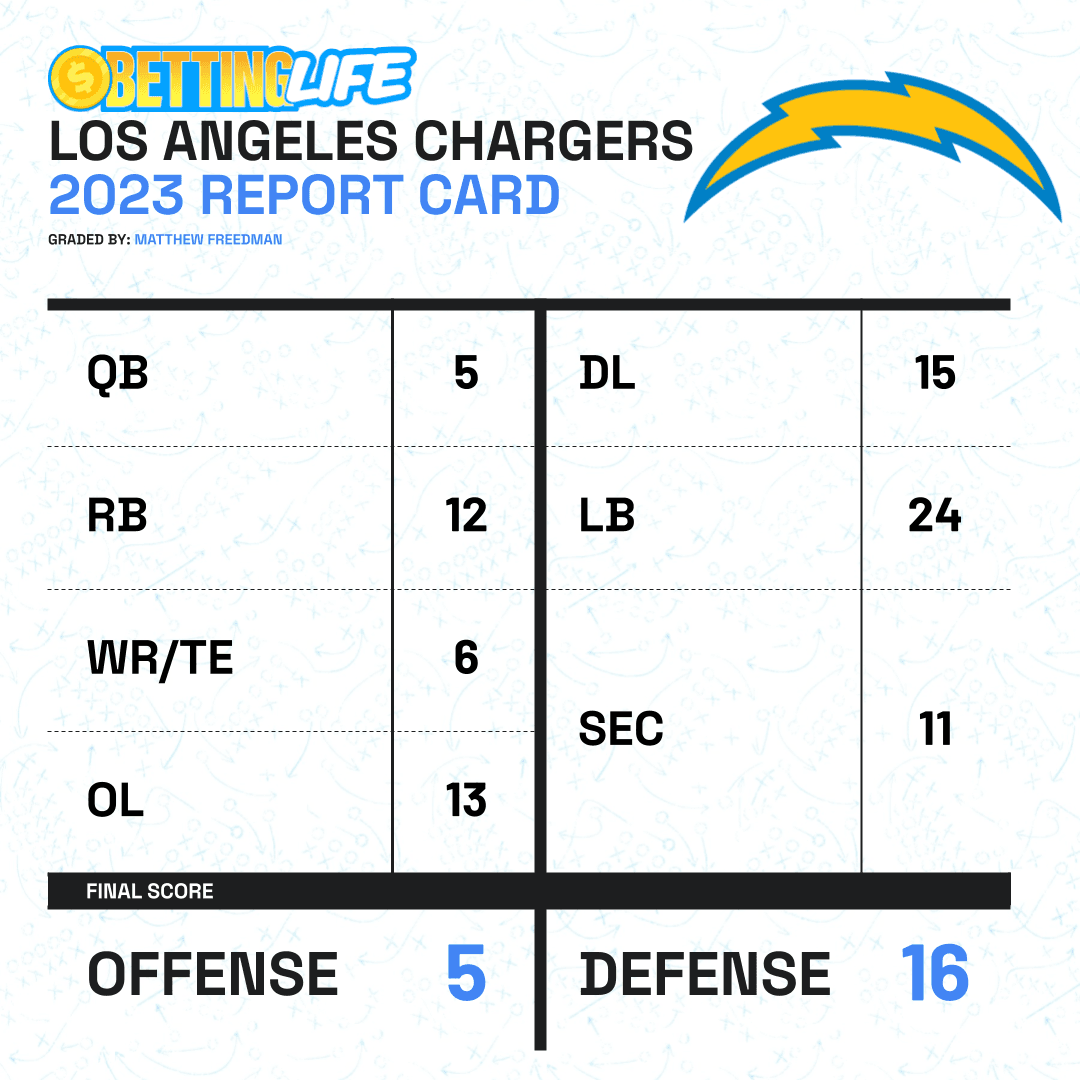
- Unit Ranking: No. 13
Slater is a 2021 first-rounder who missed most of 2022 with a biceps injury but made the Pro Bowl as a rookie. Given his age (24 years) and skill set (strong in pass protection and run blocking), he might be the NFL’s most desirable blindside bookend.
Johnson is a 2022 first-rounder who started at RG last year to accommodate the veteran Feiler but will likely shift to LG (where he played most at Boston College). He had an acceptably average rookie season but should improve as a sophomore at his native position. Linsley joined the Chargers in 2021 via a five-year $62.5M deal after a first-team All-Pro 2020 campaign and seven seasons with the Packers. He has lived up to his contract: Over the past two years, he has allowed zero sacks.
Salyer is a 2022 sixth-rounder who entered college as a five-star recruit (the No. 1 OG in his class), and he started two seasons at LT for Georgia — but he fell in the draft because of athletic and technique concerns. I believe “bollocks” is the term. As the fill-in LT for Slater last year, he allowed just five sacks in 15 starts. He’s a subpar run blocker (53.5 PFF grade), but he should be an above-average player on the interior this year.
Pipkins is a 2019 third-rounder who signed a three-year extension with the team this offseason. After serving as a swing tackle for his first three seasons, he bumped up to the starting lineup last year and was livable (32 pressures). He’s slightly subpar — but still massively better than Norton (2021 RT starter).
Sarell is a 2021 UDFA who made three spot starts last year at RT. Overall, he was bad at pass-blocking (20 pressures on 199 opportunities) and even worse at run-blocking (41.7 PFF grade). He’s theoretically the top backup tackle, but if Slater or Pipkins were to suffer an injury I expect that Johnson or Salyer would kick outside and someone else would play at guard, probably Clapp, a one-year-at-a-time veteran who allowed zero sacks last year while playing 391 crucial snaps at C in his first season with the team. But he has been a below-average player for his career and is an unfortunate option as the top interior backup.
McFadden is a fifth-round rookie with good athleticism (4.99-second 40-yard dash at 6-foot-2 and 303 pounds) and 10-plus starts at both LT and RT, but he’ll probably need to kick inside because of his lack of length. Jaimes is a 2021 fifth-rounder who has allowed five pressures on 16 opportunities in two years. That I don’t see anyone obvious on the team to challenge him for a roster spot speaks to the team’s lack of OL depth.
Defensive Line
- EDGE Starters: Joey Bosa, Khalil Mack
- EDGE Backups: Tuli Tuipulotu, Chris Rumph
- DT Starters: Sebastian Joseph-Day, Austin Johnson
- DT Backups: Morgan Fox, Otito Ogbonnia, Nick Williams, Scott Matlock
- Borderline: EDGE Brevin Allen, DT Christopher Hinton
- Notable Turnover: EDGEs Kyle Van Noy (free agent) and Derrek Tuszka (free agent), DTs Breiden Fehoko (Steelers), Jerry Tillery (Raiders), Christian Covington (Lions) and Joe Gaziano (Falcons)
- Unit Ranking: No. 7
Bosa is a four-time Pro Bowler who has generally lived up to the expectations he set with his 2016 Defensive Rookie of the Year campaign. He missed most of last season but has 50-plus pressures in every year in which he has played double-digit games. Mack is a 32-year-old third-team veteran acquired last offseason via trade with the Bears, where Staley was his position coach in 2018. His best days are behind him (2016 Defensive Player of the Year, three-time first-team All-Pro in 2015-18), but Mack is still a strong pass rusher who had 59 pressures last year.
Tuipulotu is a four-star unanimous All-American second-round rookie who will take Van Noy’s vacated place in the edge rotation. Turning 21 years old just before the season starts, he balled out last year (No. 1 in the nation with 13.5 sacks, No. 2 with 22 tackles for loss in 2022) and has the versatility to line up across the line in a variety of fronts. Rumph is a 2021 fourth-rounder who has been a distant No. 4 EDGE for the past two years. He’s yet to have a PFF pass-rushing grade above 55. He might need to compete for his roster spot with Allen, a priority UDFA rookie who started four years in college.
Joseph-Day is a 28-year-old second-contract veteran who signed with the Chargers last offseason after four years with the Rams, where he played under Staley. Although he was an effective run-stuffing nose early in his career, last year he was mainly a B-gap defender — and he had his worst year against the run (48.2 PFF grade). It’s likely that he was used suboptimally. Like Joseph-Day, Johnson joined the team last offseason in an effort to fortify the run defense. That effort failed. Johnson suffered a season-ending knee fracture in Week 9 and was in the midst of the worst run defense campaign of his career at the time of the injury. In fact, he has been steadily declining against the run since leaving the Titans (68.6 PFF grade with 2019 Titans, 52.4 with 2022 Chargers).
Fox is a 2016 UDFA who played for Staley on the 2020 Rams and joined the Chargers last year. He’s good as a pass rusher (career-high 42 pressures in 2022) but — seemingly like all of Staley’s DTs — poor as a run defender. Ogbonnia is a 2022 fifth-round nose who missed the second half of his rookie season to injury. It might surprise you to learn that in the first half of the year he was rubbish against the run (41.9 PFF grade) — but it’s true.
Williams is a 33-year-old journeyman whom Staley knows from the 2018 Bears. He was decent as a run defender (63.2 PFF grade) last year with the Giants… but he had literally zero tackles on 44 snaps five years ago in Fangio’s defense. Matlock is a sixth-round over-the-tackle rookie who projects to be his best as a pass rusher. Either Williams or Matlock could lose a roster spot to Hinton, a 2022 UDFA who… checks notes… had one solo tackle last year. When your team is bad against the run, I guess you need as many DTs as possible who don’t defend the run — because maybe a couple of them will figure out how to do it.
Off-Ball Linebackers
- Starters: Eric Kendricks, Kenneth Murray
- Backups: Daiyan Henley, Amen Ogbongbemiga, Nick Niemann
- Notable Turnover: Drue Tranquill (Chiefs), Troy Reeder (Vikings)
- Unit Ranking: No. 24
Kendricks is a 31-year-old offseason acquisition who will replace Tranquill as the team’s top backer. A 2019 first-team All-Pro, he’s an average-at-worst defender in all phases with sporadic seasons of near-elite production. He’s probably the best run-stopping LB Staley has had with the Chargers. Murray is a 2020 first-rounder who has gotten worse against the run throughout his career (60.1 PFF grade as rookie, 28.2 last year). The team has declined his fifth-year option.
Henley is a third-round rookie WR-to-LB convert with good athleticism (4.54-second 40-yard dash), a nose for the ball (200 tackles, five fumbles recovered in final two seasons) and intriguing coverage skills (5 interceptions). The Chargers probably hope he pushes Murray for playing time. Ogbongbemiga is a 2021 UDFA with 636 special teams snaps in two years; Niemann, a 2021 sixth-rounder with 684.
Secondary
- CB Starters: Asante Samuel, Michael Davis, J.C. Jackson
- CB Backups: Ja'Sir Taylor, Deane Leonard, Kemon Hall
- S Starters: Derwin James, Alohi Gilman
- S Backups: J.T. Woods, Raheem Layne
- Notable Turnover: CB Bryce Callahan (free agent), FS Nasir Adderley (Retired)
- Unit Ranking: No. 11
Samuel is a 2021 second-rounder who demonstrated marked improvement in his second season (9.4 yards per target in 2021; 7.2 last year). His physicality belies his size (5-foot-10 and 180 pounds). Davis is a 2017 UDFA who almost by default has started 64 games for the Chargers over the past half decade, but he has good size (6-foot-2 and 196 pounds) and had a career-best 51.3% completion rate last year. He’s likely to stick as a perimeter starter this year, which could push Jackson into Callahan’s available slot role, given that he has the most NFL inside experience of the three starters.
Jackson was a big-name offseason addition last year after he had an NFL-high 23 passes defended with the 2021 Patriots, but at the time of his season-ending injury he was having a hilariously catastrophic campaign (70.4% completion rate, 13.7 yards per target). He’s on track to return for 2023, and a bounceback season feels likely: He never had a PFF coverage grade below 70 prior to last year. But a patella injury plus a position change could mean that he’s in for another challenging year.
Taylor will likely be the guy who mans the slot if Jackson starts the year on PUP or struggles in his new position — although I doubt that Taylor would significantly outplay him. A 2022 sixth-rounder, he allowed 10.8 yards per target as a rookie. Leonard is a 2022 seventh-round special teams standout who had a unit-high five tackles last year. Hall is a 2019 UDFA who contributed on special teams in 2021 but dropped down to the practice squad last year. Callahan’s departure opens up a spot for him on the roster.
James is a three-time Pro Bowler who has been with the team since his 2018 first-team All-Pro rookie season. Capable of lining up all across the formation, he’s strong against the run, elite in the blitz (46 pressures on 149 pass rushes) and imperial in coverage against TEs and big WRs (5.3 yards per target for career). If he’s not the top SS in the NFL, he’s certainly in the top three.
Gilman was the No. 3 S for the past two years and now gets the chance to start alongside James following Adderley’s retirement. A 2020 sixth-rounder, he has never had a PFF coverage grade of 60 and is a backup-caliber defender.
Woods is a 2022 third-rounder who might challenge Gilman for playing time. He saw only 30 snaps last year, but his draft capital and youth (23 years) give him the developmental edge over Gilman. Layne is a 2022 UDFA special teamer.
Specialists
- Kicker: Dustin Hopkins
- Punter: J.K. Scott
- Holder: J.K. Scott
- Long Snapper: Josh Harris
- Kick Returner: Derius Davis
- Punt Returner: Derius Davis
- Borderline: K Cameron Dicker
Hopkins was a midseason addition to the Chargers in 2021, when he had a 90% conversion rate for them in 11 games, after which he received a three-year extension with $4.65M guaranteed. He suffered a season-ending hamstring injury in Week 6, which allowed 2022 UDFA Dicker to come in and drill 91.7% of his field goal attempts (including postseason) in 11 games for the team — but Hopkins (once again) had a 90% conversion rate last year before his injury, so it’s not as if he’s automatically losing his job.
The two will compete in camp, and right now I lean toward the 32-year-old Hopkins. Neither kicker has great length, but Hopkins has a solid career conversion mark of 84.8% (whereas Dicker could be a one-year wonder), and Hopkins has all the guaranteed money.
Scott is a 27-year-old veteran who joined the Chargers last year. He was a tolerable No. 16 with 38.4% of his punts downed inside the 20-yard line but a terrible No. 31 with 43.6 yards per punt. Harris long-snapped for the Falcons for 10 years before joining the Chargers last offseason. In 2021, he was a second-team All-Pro, so I’ll assume he’s good.
Davis had six return touchdowns (5 punt, 1 kick) across his TCU career, and last year he won the Jet Award as the top return specialist in college football. His ability in the return game is why the Chargers drafted him the fourth round.
Schedule analysis
Here are my notes on the Chargers’ strength of schedule and a pivotal stretch of games that I think will shape how their season unfolds.
- Strength of Schedule: No. 25
- Home Division: AFC West
- Opposing Division: AFC East, NFC North
- Key Stretch: Weeks 15-18
- Opponents: at LV, vs. BUF, at DEN, vs, KC
The Chargers have the eighth-hardest schedule based on the market win totals of their 2023 opponents, primarily because they’re in the AFC West and play the AFC East this year. Their schedule is nicely balanced in that they’re one of just four teams with no three-of-four aways, but they also have no uninterrupted back-to-back home games: Their only extended homestand (Weeks 4-6) is split up by the early bye (Week 5), which means that they have no week-to-week locational continuity and no midseason respite. That lack of a medial break (in which the players can rest and the coaches can evaluate the team) might have a big impact at the end of the year, when the team could wear down at the worst time.
In Week 15, the Chargers go to Las Vegas for a Thursday Night Football showdown with the Raiders. Although the Chargers are small favorites, they’re also on the road, on short rest and in a divisional rematch. Under those circumstances, almost anything can happen. This is prime upset territory — and then the Chargers are underdogs for the next three games: home against the Bills on Saturday in primetime, in Denver at elevation in cold weather for a divisional rematch against the Broncos and at home against the Chiefs in a divisional rematch to close the year.
Months removed from their bye, the Chargers could enter the final stretch with a real shot to go 0-4 to close the year. If that happens, they’re probably not making the playoffs and Staley’s almost certainly losing his job.
2023 worst-case scenario
As a pessimist, I think this is the realistic worst-case scenario for the 2023 Chargers.
- Telesco gives Staley a private ultimatum before the season starts — “make the Divisional Round or you’re out” — which puts Staley in a suboptimal nervous mindset.
- Staley over-experiments with his defense to try to find some magic formula to success.
- Moore dials down the aggressiveness of his offense — per Staley’s instructions — in order to control the ball and cover for the defense’s inadequacies.
- Herbert grows frustrated with the offense and his ongoing extension negotiations, so he says publicly that he won’t sign any deal until after the season, and he instructs his agent to break off contract talks.
- Ekeler has a Week 6 high-ankle sprain, which causes him to miss a month and limits him for much of the season after he returns.
- Allen slows down more, Williams misses half the year with a back injury and Johnston plays like previous TCU WRs.
- Pipkins suffers a Week 2 season-ending knee injury, and Clapp (RG) and Salyer (RT) struggle on the right side of the reconstituted OL, given that Clapp is a subpar backup and Salyer started only two games in college at RT, back in 2019.
- Bosa and Mack wear down through overuse because Tuipulotu fails to serve as an adequate replacement to Van Noy.
- The entirety of the interior DL continues to express a deep disinterest in run defense.
- Murray holds off Henley for a starting LB spot but still sucks.
- Davis is frequently targeted opposite Samuel, and Jackson starts the year on PUP and then is slow to take to his role in the slot.
- James has the worst season of his career because he overextends himself trying to pick up the slack for Gilman, who is overmatched as a starter.
- Dicker beats out Hopkins in a camp battle and then regresses to league-average performance.
- Chargers go 6-11, Staley gets fired and then Telesco — who somehow keeps his job — hires John Carroll alumnus Josh McDaniels as the next HC, after which Herbert informs the team that he intends not to sign a long-term deal and requests a trade.
2023 best-case scenario
As an idealist, I think this is the realistic best-case scenario for the 2023 Chargers.
- Telesco tells Staley before the season starts that he’ll be back no matter what for a fourth year — which is a total lie, but it boosts Staley’s confidence and gives him the assurance he needs to be an intelligent risk taker.
- Staley sees results from his defense, which finishes the year No. 5 in takeaways, and he tells Moore to go for broke on offense.
- Moore builds an aggressively fast-paced and pass-heavy scheme that becomes the first in NFL history to have four players with 1,000 yards receiving.
- Herbert breaks Peyton Manning’s single-season passing record with 5,500 yards on his way to winning a tight MVP race.
- Ekeler joins Marshall Faulk, Roger Craig and Christian McCaffrey in the 1,000-1,000 club thanks to a player-encouraged late-season push that nets him Offensive Player of the Year.
- Allen and Williams stay healthy enough and Johnston exploits soft coverage as all three serendipitously go over the 1,000-yard mark in a Week 18 home shootout with the Chiefs.
- The offensive line sustains no serious injuries and is healthy entering the playoffs.
- Bosa and Mack form a feared pass-rushing trio with Tuipulotu, who finishes No. 3 in Defensive Rookie of the Year voting.
- The interior DL improves just enough in run defense to make it not a total liability, and most opponents abandon the run early because of how dominant the Chargers are on offense.
- Henley replaces Murray as a starting LB and is adequate, which is a significant step up.
- Samuel, Davis and Jackson anchor what becomes known as “The Light Brigade Secondary,” as all three corners nab five-plus interceptions.
- James earns his second first-team All-Pro designation.
- Hopkins beats out Dicker in training camp and then hits 90% of his field goals again.
- Chargers go 13-4, finish with the No. 2 record in the AFC, revenge last year’s postseason loss with a 31-20 Wild Card win against the Jaguars, exorcize their demons with a low-scoring three-point Divisional Round victory against the Chiefs, gift Staley a 38-17 AFC Championship blowout of the Dolphins (and Fangio’s defense) — all on the road (as the No. 5 seed, because they didn’t win the AFC West) — and then remind the Cowboys of how good Moore’s offense is in a 31-24 Super Bowl upset that makes Tomlinson cry tears of joyous relief.
In-season angles
I view the Chargers as a slight “bet against” team that offers the possibility for some intriguing synthetic middles. For instance, one could bet on the Chargers as underdogs to cover the spread but lose outright. Historically, such a bet has been profitable.
- Herbert as Underdog: 12-6 ATS (28.0% ROI)
- Herbert as Underdog: 5-13 ML (8.3% ROI for faders)
We see a similar dynamic with Herbert and the Chargers on the road.
- Herbert on Road: 15-10 ATS (15.4% ROI)
- Herbert on Road: 11-14 ML (13.4% ROI for faders)
If I had to describe the Chargers to someone, I’d probably say something like, “They’re a team that’s good enough to compete — good enough to get close — but not good enough to win.”
And that’s what we see in their historical performance: Because of their talent, they can rise to meet their negative circumstances — being underdogs, being on the road — but they rise only so far. They can rise up, but they tend not to rise above.
Data from Action Network, includes playoffs.
Offseason market to exploit
In the win total market, there is one side that I prefer.
Chargers Under 9.5 Wins (+104) (FanDuel)
I prefer to bet unders in the win total market, which books tend to inflate.
Let me explain. There are 272 games this year, so we should theoretically see 272 wins in the market. But if you shopped around and found the best over line for every team across the market, the total number of wins would add up to 269.5. So there are probably some teams that are underpriced, given the +2.5 wins of value.
At the same time, if you shopped for the best under line for every team, the total number of wins would be 278, which provides a theoretical value of +6 wins to the under.
I prefer unders in this market because that’s the direction the inflated lines push me in.
Plus, I have the Chargers projected for 8.8 wins, and that delta of 0.7 wins (9.5 market wins minus 8.8 projected wins) is one of the largest such spreads between the market and my projections.
The Chargers are a talented but top-heavy team. If everything were to go right for them, I could see them winning the Super Bowl.
But if Staley stagnates as a coach, or if Moore is slow in getting the offense to understand his system, or if the team suffers more than a couple of injuries and is forced to start backups for a significant period of time, then the Chargers could underperform expectations.
I find their lack of depth especially troubling. When creating the 53-man projection, it was hard to find enough guys I like to fill out the roster.
I actually don’t hate a barbell approach to the Chargers. If they stay healthy, they could win a championship. I could see betting on them to win the Super Bowl or the AFC. (For the record, I haven’t placed either of those bets.) But if they get hit with injuries — and most teams do — they could significantly disappoint.
Remember, Staley is 0-2 so far in the win total market, having underperformed each year by half a win. I’m betting he completes the hat trick.
You can tail the under on FanDuel Sportsbook, where you can also get a No Sweat First Bet of up to $1,000 by signing up below!

Premium
Get $25 Guillotine League Credits When You Join FL+
Lorem ipsum dolor sit amet, consectetur adipiscing elit. Nunc tinciedunt, ex sit amet cursus gravida, dui mauris vulputate felis.
